



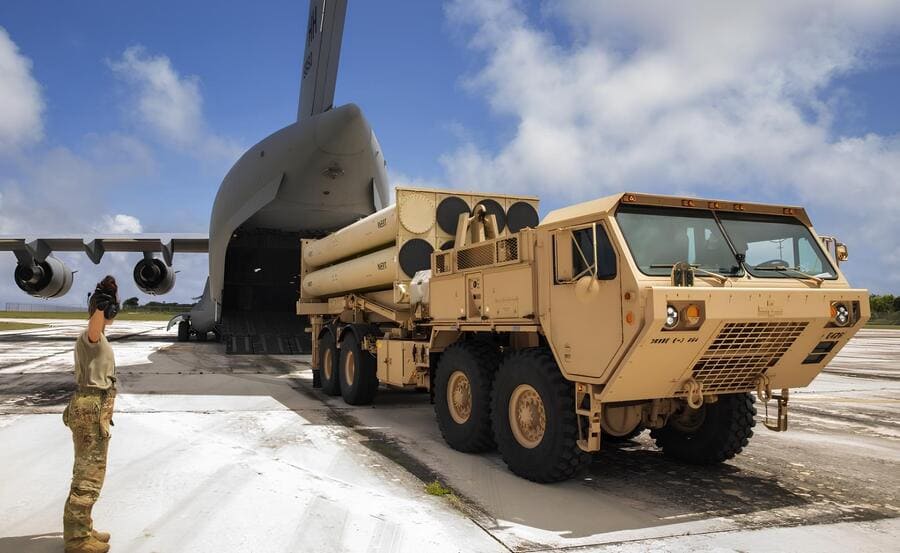
Recently, Chinese expert Guo Yanying announced that on December 27, 2024, the THAAD (Terminal High Altitude Area Defense) system deployed in Israel successfully intercepted a Palestine-2 medium-range hypersonic missile launched by Houthi rebels in Yemen.

This was the first time that the THAAD system had successfully intercepted a hypersonic missile in actual combat. However, the Israeli military did not subsequently use the system to intercept a new Palestine-2 missile launched by the Houthis. It is speculated that this may be due to the THAAD system’s insufficient capability to intercept hypersonic missiles and its low interception success rate.
Furthermore, as part of its military spending reduction plans, the United States has approved a contract between the Department of Defense and Lockheed Martin for the development of the THAAD-6 anti-missile system, designed specifically to intercept hypersonic missiles. The Department of Defense has also asked Lockheed Martin to integrate the THAAD system with the Patriot-3 system and link it to the US Army’s Integrated Battle Command System.
Back in 2015, Lockheed Martin, on behalf of the US Army, had already upgraded the THAAD system with an improved model known as Enhanced THAAD. Analysts suggest that the US Army is pinning its hopes on upgraded models of the THAAD to intercept hypersonic weapons. By integrating THAAD, Patriot, and other missile defense systems with the Integrated Air and Missile Defense Battle Command System (IAMD-IBCS), it will be possible to carry out operations and further improve the effectiveness of hypersonic missile interception.
The THAAD system is said to be the only ground-based missile defense system in the world capable of intercepting ballistic missiles both inside and outside the atmosphere. Since Lockheed Martin resumed development of the system in 2004, 19 interception tests have been completed by the end of 2022, with 16 successful interceptions, for an interception rate of 84%. Notably, all 19 tests intercepted ballistic missiles, with few hypersonic missiles as targets. Some analysts believe this is because the United States has not yet produced a standard hypersonic missile for interception testing.
Hypersonic missiles have two main technical characteristics: 1) supersonic flight, exceeding Mach 5 (6,1745 km/h; Mach is the ratio of the speed of an object to the speed of sound in the medium through which it is moving, be it air, water, or other); 2) the ability to perform highly maneuverable trajectory changes in their terminal phase. Trajectory changes pose a greater challenge to defenders than supersonic speeds. In general, incoming hypersonic missiles fly mainly in the atmosphere. While their mid-course speeds exceed Mach 10 (12,348 km/h), their maneuvers in the terminal phase reduce this to Mach 5-8 (6,174-9,878.4 km/h).
At this point, the interceptor’s maneuverability becomes crucial, while speed becomes relatively secondary. Maneuver overload refers to the maximum acceleration a missile can withstand during rapid direction changes or other drastic maneuvers. It is the main indicator of an interceptor’s ability to quickly change its trajectory to hit a maneuvering target.
So, are there typical maneuvering trajectories for hypersonic missiles that could make it easier to intercept them? Unfortunately, researchers have not even been able to come up with an approximate mathematical expression. Therefore, not only is it difficult to produce target missiles, but computer simulations are also complex. Ground-based radars are even less likely to track and intercept targets by predicting their trajectory, as they do with ballistic missiles. This is the main difficulty in developing missile defense systems against hypersonic missiles.
In recent years, due to the rapid development of hypersonic weapons by Russia, the US military believes that the current need for defense against hypersonic missiles has exceeded the demand for this type of weapon.
According to international media reports, senior officials at the US Missile Defense Agency have reached a consensus on the development of a hypersonic missile defense system: firstly, defense against hypersonic missiles and defense against ballistic missiles can be combined into a single system, eliminating the need for a separate system; in addition, the interceptors of existing missile defense systems all use a hit-to-kill/Kinetic Kill Vehicle approach, with a certain level of maneuverability overload. With further upgrades and modifications, they can be used to intercept hypersonic missiles; thirdly, the integration of different anti-missile weapons into an integrated combat command and control system for air and missile defense will further improve the combat effectiveness of the overall system.
However, Lockheed Martin acknowledges that the current THAAD interceptor missile has two major technical flaws. First, its radar range is limited to only 200 kilometers, which means that the system does not have time to perform a second interception after an initial failed interception. Second, as the interceptor missile enters and exits the rarefied atmosphere, the fuel in its single-stage rocket is depleted, resulting in insufficient maneuverability and difficulty in intercepting medium- and long-range hypersonic missiles. Lockheed Martin believes that upgrading the THAAD interceptor missile’s single-stage rocket with a two-stage one could solve these problems and improve the system’s operational performance.
The 2025 upgraded model, called Enhanced THAAD, uses a two-stage solid-propellant rocket with significantly increased thrust. This not only increases the interceptor’s range to 600 kilometers, but also increases its maneuverability by 10 to 40 times, allowing the system to achieve multiple interception opportunities and thus improving its success rate against hypersonic missiles. In addition, this upgrade improves the THAAD interceptor’s attitude and trajectory control system, enabling precise control of the intensity and direction of the thrust used to adjust attitude and trajectory.
In theory, the evolution of the THAAD prototype into the Enhanced THAAD system demonstrates significant technological innovation, offering hope to the US Department of Defense.
At the same time, the S-500 Prometheus is Russia’s latest-generation long-range surface-to-air missile system, designed to intercept a variety of advanced threats, including hypersonic weapons, ballistic missiles, and even satellites in low Earth orbit. It is intended to become a key component of Russia’s integrated air defense network, serving as an external mobile defense layer. It entered service at the end of 2024. This system has a range of between 40 and 180 kilometers and, like the THAAD, can intercept ballistic missiles both inside and outside the atmosphere. Its air defense range is 600 kilometers, a feature absent in the THAAD. In contrast, the Enhanced THAAD system has yet to be formally finalized, and no physical prototypes have been presented to the public. This may be due to technical challenges hindering its research and development.
So, is the THAAD-6 missile defense system really an upgraded THAAD? The information currently available is limited, making it difficult to say for sure. What is certain is that both the US Department of Defense and Lockheed Martin will draw on the experience and lessons learned from the development of the enhanced THAAD system in the development of the THAAD-6 missile defense system, leveraging existing research results and unlikely to “reinvent the wheel.”
The ultimate goal of the US Department of Defense is to integrate missile weapons such as THAAD-6 and Patriot-3 into the Army’s IAMD-IBCS to achieve unified command, information sharing, and improved operational effectiveness. The IAMD-IBCS is a key component of the US Armed Forces’ integrated air and missile defense system. By integrating various combat resources and information, the system enables real-time battlefield situational awareness, rapid combat mission assignment, and precise command of such operations, thereby improving the operational effectiveness of the system in complex battle environments.
Already in 2020, the US Army conducted several remote tests of the IAMD-IBCS and subsequently announced that the system had achieved initial operational capability and had been deployed. Many experts believe that the technical complexity of the system means that a few tests are far from sufficient. In addition, the interception tests involved only a few missile defense systems, including Patriot, Sentinel, and Avenger. The THAAD system, a primary missile weapon, was not included.
Hypersonic weapons are developing rapidly in many countries, and the US Department of Defense is looking for ways to intercept them. The system network and integrated operations are considered among the most important measures. Even before the finalization of the IAMD-IBCS, the US Department of Defense requested that the THAAD system, deployed in several countries, undergo integration testing with other air defense systems. In 2018, the THAAD and Patriot-2/-3 systems deployed in the Republic of Korea (South) underwent a Joint Contingency Operational Requirements Test. During the test, THAAD was responsible for high-altitude defense (40 to 150 kilometers), while the Patriot system was responsible for low-altitude defense (15 to 40 kilometers).
The US military hopes to achieve information sharing and hardware and software interoperability between the two systems by adding a small number of upgrades, thus enabling early detection of targets at greater distances. Tests have shown that this integrated approach gives the two systems three opportunities for interception during terminal defense, significantly improving the success rate of hypersonic missile interception. Some analysts believe that, compared to the large and complex IAMD-IBCS, this smaller networked combat system appears to be more reliable.
Giancarlo Elia Valori – Honorable de l’Académie des Sciences de l’Institut de France, Honorary Professor at the Peking University.

Giancarlo Elia Valori is a highly regarded Italian manager, playing a leading role in fostering dialogue and cooperation between countries. He is currently President of the Foundation for International Studies and Geopolitics.
(The opinions expressed in this article are solely those of the author and do not necessarily reflect the views of World Geostrategic Insights).
Note: This article, like all articles published on World Geostrategic Insights, cannot be republished without the written permission of the editor of World Geostrategic Insights.