



In October, the Diet elected Sanae Takaichi as Japan’s first female prime minister. Her Liberal Democratic Party (LDP) formed a minority government by ending its long-standing coalition with the pacifist, Buddhist Party, Komeito, and instead partnering with the Osaka-based conservative-populist Japan Innovation Party. This realignment marked a deliberate return to the LDP’s conservative core, distancing the party from the liberal, catch-all policy orientation pursued by her two predecessors, Fumio Kishida and Shigeru Ishiba.
The break was politically unavoidable. The LDP, lacking majorities in both chambers, had suffered stagnant approval ratings amid economic underperformance and lingering scandals over political funding. Faced with these liabilities, Takaichi moved quickly to reassure conservative voters, unveiling initiatives on economic security and stricter immigration control. Yet despite her extensive experience in domestic policymaking—including key ministerial posts and service as chair of the LDP’s Policy Research Council under the late Shinzo Abe—she entered office with limited exposure to grand strategy and defense policy.
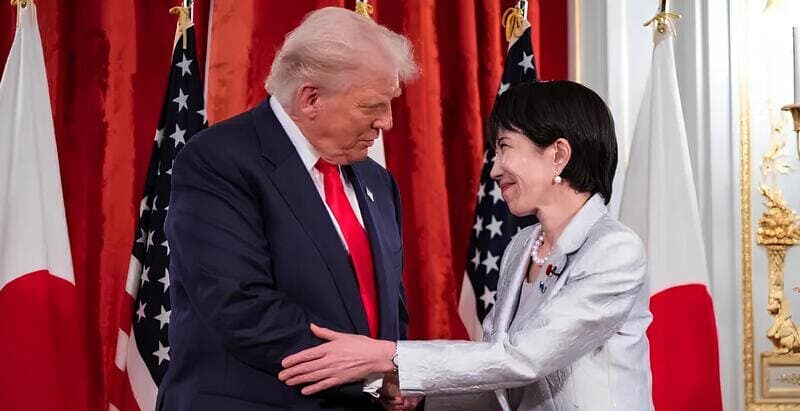
That weakness was exposed almost immediately. Barely a week into her tenure, Takaichi was compelled to host U.S. President Donald Trump in Tokyo—a leader widely expected to demand greater economic and military burden-sharing. Given Japan’s deep dependence on U.S. markets and the American security guarantee, the atmosphere was tense, particularly after Trump’s heavy-handed diplomacy had already strained bilateral ties during the Ishiba administration.
Takaichi weathered the encounter without making new commitments. Instead, she leaned heavily on international public relations. Carefully staged visuals—lavish state ceremonies in Tokyo and Trump’s dramatic welcome of Takaichi aboard the U.S. aircraft carrier George Washington at Yokosuka—were deployed to project the image of an ever-strengthening alliance.
The symbolism, however, masked a lack of substance. Notably, no joint communiqué was issued—an unprecedented omission in the long history of U.S.–Japan summit. The explanation was simple: neither the prime minister nor the Prime Minister’s Office bureaucracy was prepared. In lieu of a communiqué, the two leaders presided on October 28 over a highly ritualized signing ceremony featuring documents such as “Implementation of the Agreement Toward a New Golden Age for the U.S.–Japan Alliance,” along with memoranda on critical minerals, shipbuilding, technology cooperation, and investment.
Yet these agreements introduced nothing new. They merely reaffirmed deals already reached between the Ishiba government and the Trump administration through hard-nosed tariff negotiations conducted under stark power asymmetry. In effect, they reflected unilateral Japanese concessions driven by economic vulnerability and security dependence. Takaichi nevertheless claimed the summit marked the strongest alliance relationship ever—an assertion sustained only by rhetorical inflation. The phrase “New Golden Age” came at no additional fiscal or political cost to either leader, underscoring the performative nature of diplomacy.
Measured against outcomes rather than optics, Takaichi’s debut was no more effective than Ishiba’s—and in fact remained constrained by his legacy. The contradiction between her words and actions further compounded the problem. On the one hand, she tightly embraced the alliance with the United States, aligning herself with Trump’s “America First” and anti-globalist posture. On the other, she simultaneously championed the globalist rhetoric of a “Free and Open Indo-Pacific” and, more broadly, the liberal international order.
This strategic incoherence comes at a critical juncture. Japan faces not only protracted wars in Ukraine and Gaza, but also the growing risk of Chinese aggression in East Asia—and an increasingly uncertain United States that possesses, in practical terms, the capacity to fight only one major war at a time. In such an environment, ambiguity about Japan’s grand strategic orientation is a liability, not an asset.
The internal disarray became evident just days before Trump’s visit. On October 22, the government abruptly replaced Masataka Okano as director of the National Security Secretariat—the behind-the-scenes architect of summit diplomacy. Okano, a seasoned diplomat and strong proponent of globalist policies and the liberal international order, was dismissed after only nine months and replaced by Deputy Director Keiichi Ichikawa. The move was highly irregular: senior bureaucratic appointments in Japan typically last two years or more. Compounding the anomaly, Ichikawa had already received a warrant of appointment to Japan’s ambassador to Indonesia.
The reshuffle signaled Takaichi’s quiet departure from the globalist policy line practiced under Kishida and Ishiba. Yet it left her without a coherent strategic playbook. As a result, she faced Trump armed not with a clearly articulated grand strategy, but with residual rhetoric inherited from the former National Security Secretariat Director and his team. Unsurprisingly, she fell back on public relations while reaffirming pre-existing agreements as if they were her own initiatives.
Whether Prime Minister Takaichi can move beyond symbolism now depends on how quickly she builds a functioning national security apparatus and articulates a coherent grand strategy. Here, cautious optimism is warranted. Takeo Akiba, a veteran diplomat, remains as special adviser to the cabinet. As director of the National Security Secretariat from 2021 to 2025, Akiba was instrumental in supporting the continuation of Shinzo Abe’s approach—melding globalist rhetoric with realist policy execution.
While Kishida and Ishiba formally adhered to this line, both drifted in practice toward doctrinaire globalism. A renewed Akiba–Ichikawa axis could restore strategic integrity to Takaichi’s administration. But time is short, and the international environment is unforgiving. Diplomatic theater may buy goodwill, but only strategy sustains power.
Author: Masahiro Matsumura – Professor of International Politics and National Security at St. Andrew’s University in Osaka (Momoyama Gakuin Daigaku), Japan.
(The views expressed in this article belong only to the author and do not necessarily reflect the views of World Geostrategic Insights).