



By Sean Philip-Corbett Nottoli
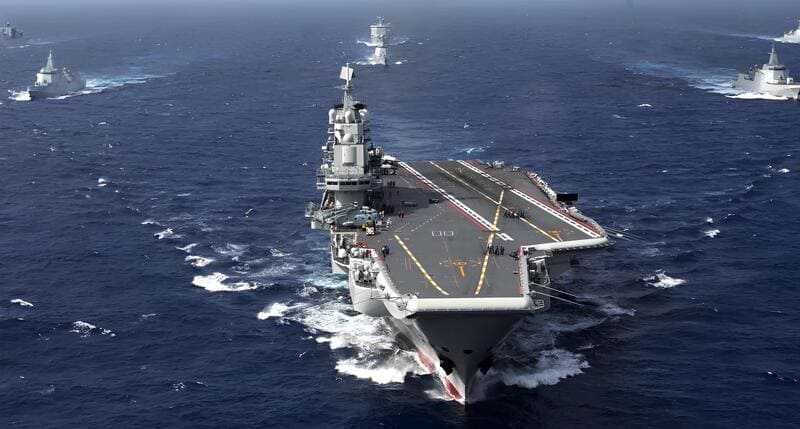
The Chinese Navy has been hard at work expanding the CCP’s influence and rewriting the totality of the international order in the Indo-Pacific.

In a bid to dominate the region, the Chinese government has created the internationally unrecognized and disputed 9-dash line, claiming territory that has long been internationally recognized as the sovereign waters of a plethora of nations in the region, from the Philippines, Vietnam, Indonesia, and more. While the regular and dangerous harassment of Filipino naval vessels, often resulting in Chinese warships even ramming them in unprovoked aggression, should be a serious cause for concern, the 9-dash line is only one small facet of the CCP’s goals in the region. More seriously, the PLA Navy plans to construct a “Great Naval Wall” to encircle the entirety of the Indo-Pacific region, and cut off Japan, Australia, New Zealand, and the rest of the area from the United States entirely.
The PLA Navy has been conducting bolder and more extensive military operations farther and farther away from Chinese shores. This past February 13th, 2025, the Chinese Navy conducted sudden live fire drills in the Tasman Sea between Australia and New Zealand without any warning. As recently released audio from Australian pilots confirms, Australian defense officials only learned about them after airline pilots flying in the area called the exercises into Australia’s civilian air authorities, warning planes to reroute lest they get caught in the PLA’s shrapnel. The live fire exercises weren’t merely a threat for civilian air traffic in the area; they were a calculated and strategic move to test Australia’s military capabilities and response. The results were alarming, to say the least. It took 40 minutes for Australian military officials to realize what was happening after the PLA Navy broadcast an emergency announcement on civilian channels, announcing their drills and advising civilian aircraft to leave the area; an eternity in military time.
These live fire drills should not come as a surprise. The Chinese government has been steadily increasing its military presence and testing the waters of Australia. Ever since 2017, the Chinese navy has been sending spy ships as far south as Sydney to gather intelligence on the current military strength of the Australian navy, and has been increasing its naval presence around Australia since. What began as the occasional presence of a singular ship has evolved into a regular incursion of Australian waters by Chinese warships, logistical support craft, spy ships, and hospital ships. If recent history has taught us anything with the war in Ukraine, when Russia began military exercises and building hospitals on Ukraine’s borders in 2021-2022, a country doesn’t dedicate these resources if it isn’t developing a plan to use them eventually.
The 9-dash line and the Tasman Sea incident are only the beginning, serving as the CCP’s litmus test to gauge its capability to assert territorial claims and how the world responds. It is clear that the CCP has aspirations far beyond the South China Sea that encompass the entirety of the Pacific Ocean. Beyond the constant harassment of Filipino vessels while in Filipino waters and the construction of artificial islands in territories belonging to other nations, the CCP has been working to encircle the countries of the Indo-Pacific and cut them off from the rest of the world, namely the United States. Chinese forces have been making regular visits to the neighboring countries of Tonga, Papua New Guinea, Fiji, and the Solomon Islands, pursuing joint defense agreements and looking for ports to host Chinese naval vessels.
In 2022, China scored a major win in its ambitions by signing a security pact with the Solomon Islands. The pact allows China to use the Solomon Islands as a base of operations to replenish Chinese vessels in the area and act as a launching point where the PLA Navy can conduct aerial and naval reconnaissance in the region. This agreement took many by surprise as the Solomon Islands recognized the ROC of China based in Taipei as the legitimate government of China, not the PRC, until as recently as 2019.
Building on its success with the Solomon Islands, Beijing has been working to increase its diplomatic engagement with the other small island states of the Oceania region of the Indo-Pacific. In August 2024, Beijing issued a joint statement with the government of Fiji during Fiji Prime Minister Sitiveni Rabuka’s visit to China, declaring the intent of both nations to increase cooperation with one another. In the statement, both countries pledged to increase political and security cooperation and solidify Fiji’s recognition of Beijing’s three primary Initiatives (the Global Development, Security, and Security Initiatives put forward by CCP Chairman Xi Jinping in 2021-2023).
Special attention should also be paid to the ongoing situation in New Caledonia. As French President Emmanuel Macron proposes a deal that would grant the current French colony more sovereignty and enshrine it in the French constitution as a new state, leaders of the CCP are eager about the idea of a sovereign New Caledonia. Not only does the French territory contain approximately 25% of the world’s nickel, it also geographically falls perfectly in line with the Solomon Islands, Tonga, Papua New Guinea, and Fiji to surround Australia and New Zealand.
China’s increased engagement and seeking security cooperation with these island nations make Beijing’s intentions clear. Coupled with the live surprise live fire exercises in the Tasman Sea, it’s apparent that Beijing is working on the development of a great naval wall meant to surround America’s allies in the Indo-Pacific, cut them off from Washington, and increase its ability to coerce them, and like an anaconda, strangle them into submission.
To counteract these plans, the United States and its Indo-Pacific allies need not only greater engagement with each other, but with the small island nations of Oceania. As the United States begins to redirect resources towards the region from Europe, Washington should increase its engagement with Tonga, Fiji, the Solomon Islands, and have teams beginning heightened conversations with the French and representatives of New Caledonia. If allowed to go unchecked, the CCP will build a literal Naval Wall of influence throughout the entirety of the region that will not only put immense pressure on countries like Australia, New Zealand, and Japan, but will also incentivize Beijing to be bolder and more aggressive than it has been with its infamous 9-dash line.
Only increased engagement and relations between the democracies of the Indo-Pacific region (including the United States) can prevent this. Not only the US, but Australia, New Zealand, and even Japan should put on a united front and have joint military and naval visits to the small island nations of the area. Heavy emphasis should be made on coordinated diplomatic outreach; Australia, in particular, should be leading the charge to increase relations with neighboring Pacific-Island states. While the US redirects its resources to the area, the other nations of the region will have to raise their commitments to regional security as well. Comparable military buildups will be the first meaningful step to signaling Beijing that its bullying tactics in the East China Sea and expansive ambitions won’t be tolerated. Through the increased cooperation, commitment, and burden sharing between the democratic states of the Pacific neighborhood, the allies can stop the construction of this naval wall and prevent incidents like the surprise Tasman Sea exercises from happening again.
Author: Sean Philip-Corbett Nottoli – Expert in American and conservative politics with over a decade of experience in campaign management and consulting across the United States. He served as a director in Trump’s last presidential campaign. He has also worked for five years with civil society organizations to promote democracy around the world. He has published articles on a variety of global topics in various formats, ranging from security policy in the Baltic region to Russian military strategy and events on the Korean peninsula in China, Japan, and other regions. His research interests include global security issues, state sovereignty, and great power competition. He is currently a Visiting Fellow at the Danube Institute in Budapest, Hungary.
(The views expressed in this article belong only to the author and do not necessarily reflect the views of World Geostrategic Insights).