



By Alamgir Gul
From the ruins of Gaza to war-torn Ukraine, from Kashmir’s tensions to the fires in Iran and Israel, the world is increasingly led by those who lack empathy, restraint, or a sense of duty. Leaders today often show a chilling disregard for human life, twist facts without shame, and cling to power with no remorse.
This is no longer just political rhetoric or abstract critique—it is a harsh reality and a global crisis. The modern age promised progress, cooperation, and diplomacy, but instead, we see rising violence, unchecked authoritarianism, and the erosion of laws meant to protect the vulnerable. Ordinary people have become pawns in power struggles, while those with the loudest weapons act without consequence.
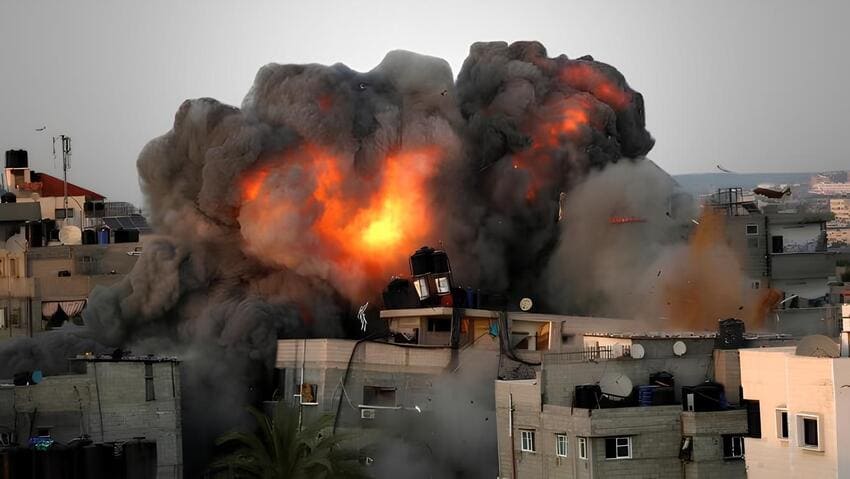
One of the most heart-wrenching examples is Gaza. Since the escalation of the Israel-Gaza war in October 2023, more than 60,000 Palestinians have lost their lives. The majority of them were women and children; entire families have been wiped from existence. Hospitals have become targets, and refugee camps have been flattened. Essential supplies like water, food, and medicines are deliberately obstructed.
Israel claims self-defense, a right no one can deny, but the scale and nature of its response go far beyond defense. The disproportionate violence, the systematic targeting of civilian infrastructure, and the collective punishment of over two million people amount to something far more sinister. These are not isolated incidents of war; they are patterns of cruelty, and the world’s hesitation to act speaks volumes. The silence of institutions and the apathy of those with influence have only deepened the despair.
The airstrike launched by Israel on June 13, 2025, under the banner of Operation Rising Lion, sent shockwaves across the world. It struck suspected nuclear and missile facilities in Iran, killing IRGC commander Hossein Salami, two nuclear scientists, and several civilians, including children. Yet, no credible evidence suggested Iran was on the verge of building nuclear weapons. Even the U.S. intelligence did not verify the claim. It is an act, devoid of evidence and circumscribed with consequences, and this is a dangerous mindset, putting control over conversation and revenge over examination.
Such tit-for-tat can take the region over the edge. A full-scale war with Iran and Israel was not only going to bring the Middle East in its entirety to war, but also introduce the possibility of the involvement of world powers and light a new chapter of devastation to international conflict.
The war in Ukraine is another gloomy instance of this emerging global madness. An invasion took place in February 2022, bringing about one of the bloodiest wars in the history of modern life. Sheltered cultural and commercial centers where people lived well are burnt to ashes. It is all about the attempts of a leader to rewrite history under the auspices of claims of security and sovereignty.
And there is India, a country usually referred to as the largest democracy in the world, yet currently heading toward a worrying path. With the abrogation of the Article 370 in 2019, under the leadership of Prime Minister Narendra Modi, Jammu and Kashmir lost its special autonomous status, followed by one of the harshest lockdowns in living memory: tens of thousands arrested without any charges, months-long internet shutdown, and the environment that lumped speaking out to sedition.
The cold hush that has fallen on Kashmir is not the hush of peace, but it is the silence of fear driven by compulsion. In the larger context, the posturing of India has become more aggressive. Fueled by the Hindutva ideology, rhetoric against Pakistan has become more inflammatory, and border skirmishes more frequent. These provocations do not emerge from genuine threats, but from political utility. In a region where both nations possess nuclear arsenals, such deliberate escalation is a gamble with unthinkable stakes.
Looming over all these crises is the stark failure of international institutions. The United Nations, once the world’s moral compass, is increasingly paralyzed. The Security Council, dominated by permanent members with veto powers, has become a tool for obstruction rather than action. Meanwhile, the International Criminal Court investigates selectively, and only where geopolitics permits. The result is a world where international law is not universal, but conditional. The strong act with impunity; the weak are punished with precision.
However, there is a face behind every statistic and policy choice. Under the debris, a child is holding their parents. A father observes his house burn to the ground. Abstractions are not what they are; these are lives, full of stories and dreams, that were obliterated because they were viewed as collateral damage by someone, somewhere. Strategy turns into cruelty, and people become barriers to political ambition when there is a lack of conscience in the leadership.
Yet, this descent into barbarism is not irreversible. There are ways forward, if only we have the courage to take them. The structure of the United Nations must evolve; the veto power must be reimagined with a more inclusive and democratic mechanism. Modern technologies, especially artificial intelligence, can be harnessed to detect signs of impending conflict, providing an opportunity for prevention rather than reaction. Nations fueling wars through arms sales must be held accountable through enforceable legal frameworks. Peace processes must shift focus from elites and militaries to those most affected, civilians, and those who bear the scars of war. Most importantly, education across the world must be transformed to cultivate empathy, teach the true costs of violence, and build a generation capable of saying “no more” before the first bullet is ever fired.
The choice remains ours. And what we choose today will echo through history for generations.
Author: Alamgir Gul – Research Officer at Balochistan Think Tank Network (BTTN), at BUITEMS, Quetta. He is a Gold Medalist and holds a Postgraduate Research Degree in Peace and Conflict Studies from National Defence University Islamabad, Pakistan.
(The opinions expressed in this article are solely those of the author and do not necessarily reflect the views of World Geostrategic Insights).
Image Credit: AFP