



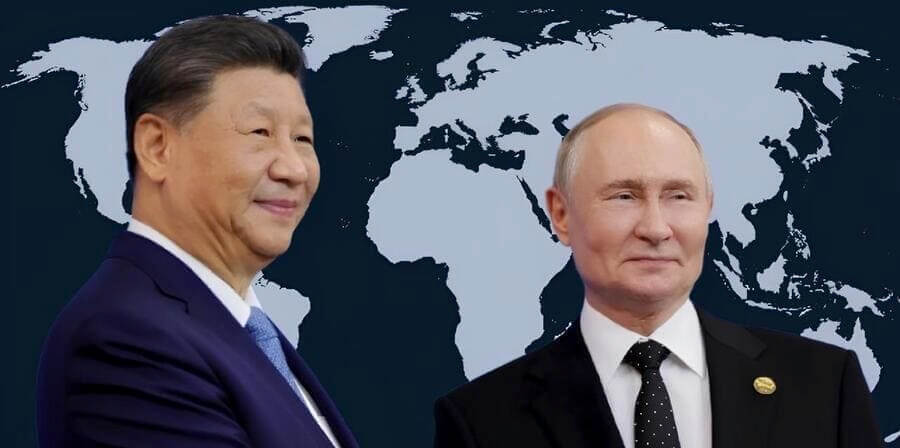
World Geostrategic Insights interview with Robert E. Hamilton on the complex dynamics of Sino-Russian relations, their regional interactions, and whether their ties could be weakened by external factors, such as the strengthening of relations between Russia and North Korea, the second Trump presidency, and European Union pressure on China over the conflict in Ukraine.

Colonel (Retired) Robert E. Hamilton, PhD, is a national security professional and scholar with 30+ years of combined experience in government and academia. During a 30-year career in the U.S Army, he served overseas in Saudi Arabia, Iraq, Germany, Belarus, Qatar, Afghanistan, the Republic of Georgia, Pakistan and Kuwait. Currently Robert is a Senior Fellow at Delphi Global Research Center. He was also a Senior Fellow and Head of Research at the Foreign Policy Research Institute’s Eurasia Program, and for six years he served as a professor at the U.S. Army War College.
Q1 – Relations between China and Russia have fueled a long-standing debate between those who consider them a strategic partnership and those who perceive them as an “axis of convenience”, an opportunistic alliance. Instead, in your book “China-Russia Relations: The Dance of the Dragon and the Bear (2024, Springer)”, you emphasize that relations between China and Russia are complex, characterized by cooperation and competition, and can best be understood through their regional interactions rather than through simplified narratives. Can you summarize here your approach in analyzing the ties between China and Russia and the main drivers shaping their relationship?
A1 – Sure, my approach assumes that we can gain a richer understanding of China-Russia relations by watching how they interact on the ground in regions of the world where they both have important interests at stake. For the book, I looked at their presence and interaction in four regions: Africa, Central Asia, Eastern Europe (the focus here was on China’s response to Russia’s invasion of Ukraine) and East Asia.
The framework I used to analyze their interaction in these regions is one based on the instruments of power (also sometimes called the instruments of statecraft); these are diplomatic, military, informational, and economic instruments. The idea behind the book’s approach is that taking a regional approach and using the instruments of power as an analytical framework will yield a more nuanced, contextualized view of the China-Russia relationship than one focused on the level of the international system.
Q2 – Your book includes a detailed analysis of Sino-Russian dynamics in key regions such as Africa, Central Asia, East Asia, and Eastern Europe, where both countries have interests at stake. Looking ahead, in which region do you think the interests of the two countries are most likely to converge or diverge? Could the so-called “unlimited partnership” be limited by changes in the geopolitical realities?
A2 – In each region examined, I characterized Chinese-Russian interaction as cooperative, compartmented, or competitive. The idea behind the “compartmented” label was places where both are present but they are neither partners nor competitors, instead each pursues its own interests with little to no regard for what the other is doing – Africa provides the best example here.
Central Asia is the area where their interests are most divergent, especially in the economic realm. First their economic visions for the region – characterized by the Silk Road Economic Belt (SREB, part of the Belt and Road Initiative, or BRI) and the Eurasian Economic Union (EEU) – are mutually exclusive.
The SRB/BRI is part of an attempt to establish an open global trading system with China at its center, while the EEU is a closed customs union dominated by Russia. Next, China is replacing Russia as the economic hegemon in the region, including by building pipelines for Central Asian oil and gas to China, where export pipelines were previously dominated by Russia.
East Asia is the region where their interests are most convergent, driven by the increasing US-China security competition there. As the region bifurcates into two mutually exclusive security blocs, there will be little room for countries, like Russia, to sit out any US-Chinese confrontation. Instead, Russia and China are increasing their interaction in the region, especially in the military domain. While there are irritants in the relationship (like Russia’s close ties with Chai’s historical foe Vietnam) the general trend is toward convergence of interests.
Q3 – Relations between Russia and North Korea have developed rapidly in recent months, leading even to a security partnership. Some analysts believe that the ever-closer alliance between North Korea and Russia is causing concern in China. What is your opinion?
A3 – The increasingly close Russia-DPRK relationship is likely not fully welcomed in Beijing. The DPRK has long been an unpredictable ally for China, and there are doubtless concerns that Russia’s explicit backing for North Korea could cause Pyongyang to run risks in its relationship with the US that China would prefer not to underwrite.
China’s focus is on resolving the Taiwan issue and it probably is unenthused about anything that might distract it from that goal or bring on a confrontation with the US over issues Beijing considers important but not vital. Beijing’s main goal on the Korean Peninsula is a negative one: prevent a united, democratic, US-friendly Korea. It would prefer the status quo to any situation that may cause the collapse of the DPRK and bring about a united Korea allied with the US.
Q4 – Officially, Russia in Southeast Asia strongly supports Beijing’s position on controversial regional issues such as Taiwan and the South China Sea. However, some analysts believe that President Trump is implicitly trying to weaken China geopolitically by distancing Moscow from Beijing. What is your opinion? If so, would any attempt by Trump to drive a wedge between the two countries have any chance of success?
A4 – This is the “Reverse Kissinger” idea; while an attractive proposition, it has little chance of success. First, when the Nixon/Kissinger Administration undertook the opening to China, it did so by exploiting an existing rift in the Chinese-Soviet relationship. The US had long assumed that since they were both Marxist governments, the USSR and the PRC would get along. But the US became aware in the late 1960s that the relationship was fraught, including small military skirmishes along their common border.
The US exploited this rift by reaching out to China to draw it away from the Soviet Union. There is no such fundamental rift in the relationship to exploit today; on the contrary, were the US to insert itself into the China-Russia equation it would draw them closer together, not pull them apart. While they have differences, they share a strong belief that the US threatens their internal stability and limits their external freedom of action.
Q5 – The European Union (EU) and China held their 25th summit in Beijing on July 24, 2025. The EU urged President Xi Jinping to use his influence to convince Putin to agree to a ceasefire, and support a just and lasting peace in Ukraine, based on the principles of the United Nations Charter. However, it seems that Beijing does not want Russia to be defeated in Ukraine and, despite the importance of trade between the EU and China, in the past, Beijing has shown no intention of persuading Putin to reconsider his position on Ukraine. So what is the point for Europe to continue to expect China to mediate or distance itself from Russia over the war in Ukraine?
A5 – Europe’s outreach to China over Ukraine is almost certainly a result of the feeling that the US is no longer a reliable partner, and that therefore rather than unite with the US to force Russia into suspending the war, Europe can possibly work with China to induce Russia to do so. If the US returns to a policy of pressuring Russia by supporting Ukraine, the EU will likely be less interested in partnering with China to end the war.
China has been clear that it has no interest in Russia losing the war in Ukraine, because that would free up the US to confront Beijing in East Asia. This highlights one of the most negative aspects of US policy toward Russia and China, especially under the Trump Administration.
Although Russia represents an acute, militarized threat to US interests in Europe and beyond, the US has been ambivalent about confronting and stopping Russia’s aggression in Europe. Instead, China hawks in the administration have argued for cutting aid to Ukraine to focus on being ready for war with China. Rather than looking at the war in Ukraine objectively then, Beijing looks at it through the prism of a coming confrontation with the US. Through this lens, China needs a strong partner in Russia. Were it not convinced that a US-China military confrontation was likely, China would probably take a more balanced approach to the war in Ukraine.
Colonel (Retired) Robert E. Hamilton, PhD – National security professional and scholar.