



By Muhammad Azam Tariq
Writer is a Pakistani researcher and socio-political analyst specializing in international relations, geopolitics, and global governance.

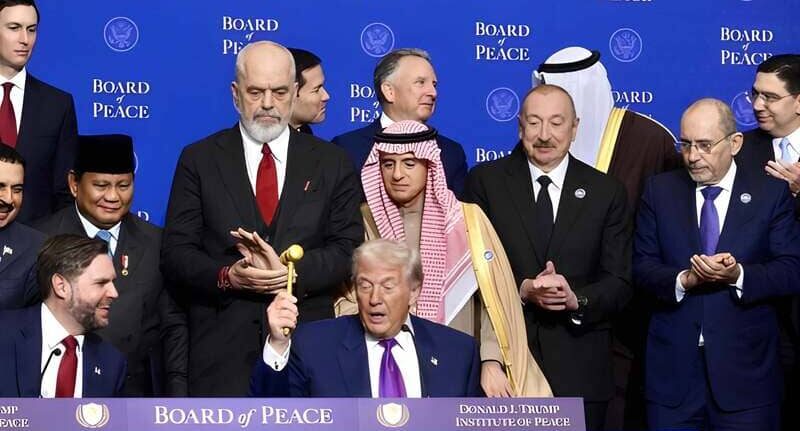
In recent days, discussions within international political circles have suggested that a newly proposed “Board of Peace,” reportedly initiated through the efforts of Donald Trump, could potentially replace the United Nations. While such claims generate curiosity and debate, they remain largely speculative and analytically overstated. The structural depth, historical legitimacy, and universal recognition of the United Nations cannot be displaced merely through the announcement or sponsorship of a new diplomatic initiative.
The United Nations was established in 1945 in the aftermath of the Second World War with a foundational mandate: to prevent large-scale global conflict, foster dialogue among sovereign states, uphold international law, and promote collective security. Over decades, it has developed a complex institutional architecture comprising the General Assembly, the Security Council, the International Court of Justice, and numerous specialized agencies. Its near-universal membership grants it unparalleled diplomatic legitimacy. Even when criticized for inefficiency or political paralysis, the UN remains the central arena where international norms are negotiated and disputes are formally addressed.
Historically, major powers have sought to reshape or supplement global governance structures in response to shifting geopolitical realities. From the creation of regional alliances to the establishment of economic blocs, powerful states frequently attempt to design mechanisms that better align with their strategic interests. In this broader historical context, the idea of a “Board of Peace” can be interpreted not as a revolutionary alternative but as part of an ongoing pattern of institutional experimentation. Superpowers, observing transformations in global power distribution, often introduce parallel forums to amplify their influence.
However, the emergence of supplementary mechanisms does not equate to the dissolution of established multilateral institutions. The United Nations is anchored in an international charter ratified by sovereign states, and its continuity is sustained by collective consent rather than unilateral sponsorship. Replacing it would require a profound restructuring of global consensus, something far more complex than proposing a new body, regardless of political backing.
From the perspective of Realist theory in international relations, such initiatives are unsurprising. Realism posits that global politics is fundamentally shaped by power dynamics and national interests rather than idealistic aspirations. If a dominant power promotes an institution that reflects its geopolitical priorities, this aligns with the logic of state-centric competition. In this view, a “Board of Peace” would likely function as an instrument through which its sponsor seeks to shape diplomatic narratives, mediate conflicts selectively, or project normative influence.
The critical question, therefore, is not whether such a board can replace the United Nations, but whether it can acquire comparable legitimacy. Legitimacy in international politics emerges from broad-based participation, legal recognition, and institutional continuity. Without universal membership and collective endorsement, any new body would remain limited in scope, operating as a complementary or parallel forum rather than a substitute for the global order’s primary institution.
In conclusion, while debates about reforming or supplementing international institutions are both natural and necessary, predictions about the imminent replacement of the United Nations appear premature. The “Board of Peace,” if realized, may contribute to diplomatic dialogue in specific contexts. Yet the structural foundations and symbolic authority of the United Nations remain deeply embedded in the architecture of contemporary international relations.
Author: Muhammad Azam Tariq – Pakistani researcher and socio-political analyst specializing in international relations, geopolitics, and global governance.
(The opinions expressed in this article are solely those of the author and do not necessarily reflect the views of World Geostrategic Insights).
Image Source: EPA-Yonhap (Inaugural Board of Peace meeting in Washington, Feb. 19).