



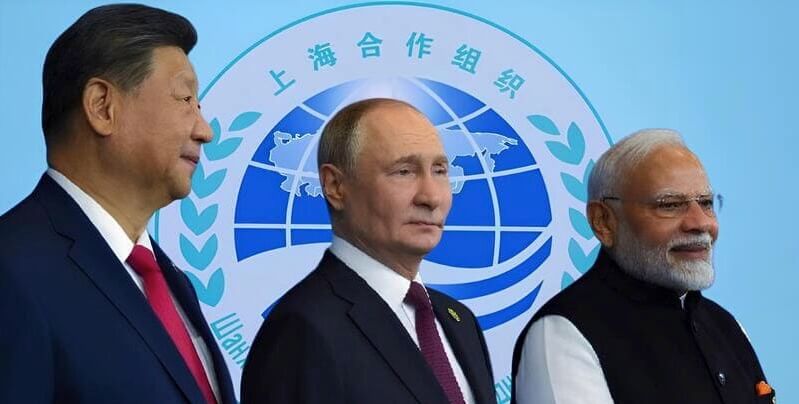
The 25th SCO Summit in Tianjin, China, drew over 20 national leaders and eight organizations, marking a historic event with record participation.

At the center of the discussions was China’s initiative on global governance, which emphasized the importance of respecting the United Nations Charter and the union of nations to address global challenges without aiming world domination.
The summit highlighted the cooperation between China and Russia, with a shared vision of global governance based on sovereign equality and multilateralism. The Tianjin Declaration also outlined various initiatives, including the establishment of the SCO Development Bank, collaboration on security, and the condemnation of terrorism and violence, signifying a shift toward a new global order.
China’s Global Governance Initiative and Compliance with UN Charter
The focus of the Summit was the Global Governance Initiative, put forward at the plenary session of the Summit by Chinese leader Xi Jinping. This clearly indicates the increasing influence of the SCO on the world stage, capable of dealing not only with economic issues and developing cooperation, ensuring security, but also uniting all countries, regardless of their size and economic power, to bring them into line with modern realities and, most importantly, with the provisions of the UN Charter.
Should it be noted that the SCO and China do not seek world domination or to replace the UN; this interpretation is absolutely unacceptable. There is about the principles laid down in the Charter of the United Nations, which should be taken as the basis for the international activities of organizations. The direct connection of the global world order in accordance with the principles of the UN is emphasized by the presence of UN Secretary General Antonio Guterres, who spoke at the “SCO Plus” session during those days.
Western experts are looking for a challenge to the West, a hidden threat, a desire to dismantle the existing mechanisms of global governance in the actions of the “global majority”. However, the wording of the Chinese initiative suggests otherwise.
China accuses the West of being committed to the “Cold War mentality” and of wanting to create closed groups aimed at protecting the narrow selfish interests of a group of countries, rather than solving the problems of all mankind. Increasingly moving away from the principles of the UN, the West resorts to the principles of intimidation and pressure.
Russia and China – a Common Vision of World Order
At the SCO Summit, Xi Jinping called on like-minded countries to join his Global Governance Initiative. Earlier, an understanding had been presented on establishing relations in the field of economic cooperation, security and civilizational dialogue. At a meeting with the President of Russia in Beijing, Xi Jinping emphasized that the two countries have a similar opinion on the global governance system, adhering to the principles of sovereign equality, compliance with international law and multilateralism. These are the key components of the Global Governance Initiative.
Lessons from the USSR
In the second half of the 1980s, the concept of universal human values spread in the USSR with a discussion of ways to solve universal human problems. These thoughts were not mistaken. However, the Soviet Union tried to address global problems without having a sufficiently solid foundation – a sustainable economy. China, however, has learned the corresponding lesson and now, being the second largest economy in the world, talks about the universal values of humanity that bring all countries and civilizations together and should not be imposed on anyone. It proposes to form a broad international consensus.
Victory Parade
It is worth noting the exclusive agenda of the Summit, dedicated to the 80th anniversary of the Second World War and China’s victory over militaristic Japan. The main guest of the SCO Summit and events was Russian President Vladimir Putin, which indicates a warm welcome in China, the number and duration of meetings, and the number of documents signed. China and the USSR were the main restraining forces of fascism and suffered the greatest losses in this war. The main force of resistance to fascism in the West was the Soviet Union, in the East – China. From the early 1930s, China had to resist Japan until the war escalated to a larger scale. Therefore, China is an equal among the victors. By hosting a large Victory Parade, China demonstrates its military power and readiness to defend its interests and borders. These are Beijing’s soft and hard powers.
The largest SCO summit in the history of the association was held in the Chinese city of Tianjin from August 31 to September 1, which can be called one of the most important events and the beginning of a new world order.
At the end of the Summit, the central document of the summit was adopted – the Tianjin Declaration.
The Tianjin Declaration 2025
Among the main points, the document includes decisions on the creation of the SCO Development Bank, support for Afghanistan’s development efforts, cooperation in the field of security in relation to artificial intelligence, drug trafficking, the preservation of a weapons-free space, the elimination of barriers in sports, science, agriculture, tourism, transport, and e-commerce, the promotion of strengthening the institution of the family, as well as the development of cooperation and adaptation of the United Nations to modern political and economic realities.
In addition, the declaration condemns terrorism in all its forms, US and Israeli attacks on Iranian nuclear infrastructure and the Gaza Strip, and contains a statement of readiness for military cooperation. An agreement was also signed to counter threats to the security of member states.
The UN General Assembly resolution on combating the glorification of Nazism was welcomed, the need to reflect the historical truth about World War II was declared, and the importance of dialogue with the EAEU and ASEAN was emphasized. In accordance with the document, the presidency was transferred to Kyrgyzstan.
Author: Tatiana Pokrovskaia – International business development professional with more than 20 years of experience in the markets of Africa, CIS, Asia and the Middle East, repeatedly bringing Russian companies into international markets. She is based in St. Petersburg, Russia.
(The views expressed in this article belong only to the author and do not necessarily reflect the views of World Geostrategic Insights).