



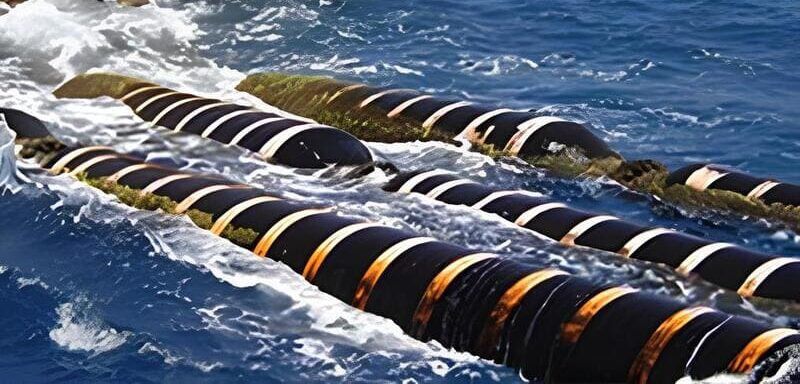
Submarine cable systems are the backbone of global and regional internet connectivity. These are optical fiber cables laid under the sea to transmit data over long distances between land-based stations that carry most of the international internet traffic from data to video and voice.

These cable systems usually consist of main trunk lines and branching units that are connected to multiple landing points. They are engineered to withstand marine conditions with protective layers for signal amplifications and branching units.
The Philippines is an archipelago of 7,461 islands and submarine cables are essential to connect Luzon, Visayas, and Mindanao, and to link the country with the rest of the world. They provide international bandwidth to other countries and with domestic inter-island services to improve redundancy, latency, capacity, and resilience against outages. They are critical in cloud armies, data centers, streaming, and the digital economy. Presence of regional and domestic cable partnerships carry the burden of protecting the longest domestic underwater fiber network in the country and around maritime Southeast Asian neighbors. The strategic location of the Philippines is a vital location for international fiber optic cables, linking parts of Asia to two of the world’s biggest economies — the United States and China.
Some of the notable cable landing stations in the country are in Cavite, Batangas, La Union, Daet, Baler and Digos in Mindanao. While there are challenges in terms of physical damage brought by massive fishing activities to natural calamities like earthquakes, landslides, and storms — it requires specialized cable ships for maintenance and repairs, taking months for restoration, depending on the location and depth of the break. But strong environmental regulations and permits are costly that bring excessive costs in laying capital-intensive cables undersea because these fiber optical strings cross territorial waters and concerns of imminent and present dangers could cause possible geopolitical disruptions and international relations interventions.
Means of securing submarine cable systems in the West Philippine Sea within the larger South China Sea adjacent to western Luzon could be daunting as numerous ways as intra-Asia and ASEAN cables cross this body of water between Southeast Asia, China, Taiwan, and Japan hubs. Meanwhile, the Benham Rise or Philippine Rise is a large submarine plateau east of Luzon.
The Philippines holds sovereign rights in the new maritime territory that has been designated as a marine reserve or protected area. Geological maps show it rising thousands of meters above the surrounding seafloor. The world’s largest submerged caldera, an underwater volcano, is found also within the Benham Rise. Although, public system maps do not list many major cable trunks explicitly routed across the central plateau of the Philippine Rise; at present, there is no prominent set of major internal trunk cables publicly documented as intentionally routed across the maritime richness of the Benham Rise.
Since submarine cable systems intersect the seas of the Philippines, the Asia-America Gateway (AAG) is an intra-Asia and trans-regional trunk with landings in La Union facing the West Philippine and the South China Sea. SEA-H2X is a recent China-built intra-Asia system that also lands in La Union in Luzon that connects to Hainan and Hong Kong that passes through the Philippines with landing stations in west and northwest Luzon going to different parts of the ASEAN region.
The SEA-US submarine cable system links the Philippines with Guam, Hawaii, and the U.S. West Coast, and its cable systems land in Davao for the southern corridor. Domestic cables used by the Philippine-based giant telcos have landing stations in Aurora, Batangas, Cavite, Davao, and La Union. These determine where international systems land and where traffic traverses in the West Philippine Sea and the Benham Rise.
There are proposed trans-Pacific and new intra-Asia systems where submarine cables take the northern route via Taiwan and Japan and may even approach the eastern side passing totally through the Philippine Rise. Routing choices are commercial and geostrategic in nature, as maps and operator announcements present where they land whether to cross the tensed West Philippine Sea and extend the lines to the controversial South China Sea to the bigger Benham Rise.
Protecting submarine-cable infrastructure that crosses or lands in the contested West Philippine Sea and larger Benham Rise should usher legal and policy measures in ocean zoning, technical design, and operations. There must be existing national instruments to set rules for cable routes, permitting and penalties. The United Nations Convention on the Law of the Sea (UNCLOS) requires states to avoid willful damage to cables. Regulation of maritime activities in the exclusive economic zone and continental shelf of states should translate those obligations into local permitting, criminal penalties, and administrative rules.
The Philippine government must designate sea lanes in Philippine Rise since the area is a marine reserve while the West Philippine Sea is a metacenter for diverse marine ecosystem that comprises an estimated 30 percent of the coral reef in the country and contributes to 27 percent of the Philippines’ commercial fisheries production, a crucial source of blue economy and food security. There should be demarcated official cable protection zones and publish them on nautical charts and coordinate notices to mariners to reduce accidental damage from anchoring and fishing and to map hazards publicly. This is to encourage spatial separation between cables, pipelines, and other seabed users including naval submarines and submersible drones. There should be integrated routing that is marked in national marine spatial planning where seabed geomorphology lowers physical risks and avoids ecologically sensitive cores of marine-protected areas.
The strategic network of submarine systems in the Philippines should enable national connectivity and digital sovereignty. The archipelagic geography of the country with long-distance data links must cross water and submarine cables which are the core infrastructure of the national internet backbone with 99 percent of international data traffic passing through the country’s seabed. A strategic national network ensures that major island groups from Luzon, Visayas, and Mindanao, including multiple coastal provinces have either redundant high-capacity cable routes that prevent isolation during faults and natural disasters.
Without a coordinated network plan, the Philippines risks uneven connectivity where only few commercial landing hubs have strong international links while other regions depend on fragile backhaul. Lastly, control over cable routes ensures strategic autonomy for sensitive government and classified military data sent through domestic and allied systems rather than foreign-controlled underwater cables.
Author: Dr. Chester Cabalza – Founding President of the Manila-based think tank International Development and Security Cooperation (IDSC).
(The views expressed in this article belong to the author and do not necessarily reflect the views of World Geostrategic Insights).