



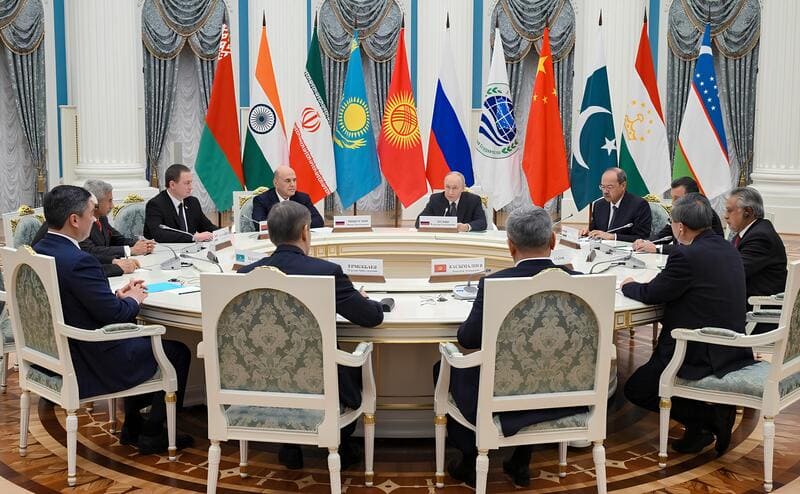
World Geostrategic Insight interview with Tatiana Pokrovskaia on how the Shanghai Cooperation Organization (SCO) is transitioning from a predominantly security-focused entity to a major economic bloc, transforming the diversity of its members’ political systems and foreign policies into strategic cooperation, and the outcomes of the November SCO Council of Prime Ministers meeting in Moscow.

Tatiana Pokrovskaia is an international business development expert with more than 20 years of experience in the markets of Africa, CIS, Asia and the Middle East, repeatedly bringing Russian companies into international markets. She is based in St. Petersburg, Russia.
Q1 – The Shanghai Cooperation Organization (SCO) is evolving from a security-focused group into a major economic bloc with the ambition to shape global trade and provide an alternative to Western-dominated international economic systems. In general terms, how effectively can the SCO harmonize the diverse political systems and foreign policy alignments, and sometimes competing interests of its major member powers, specifically China, Russia and India?
A2 – The Shanghai Cooperation Organization has indeed expanded its mandate from its initial foundation of safeguarding regional security to becoming a comprehensive platform for multifaceted cooperation. The diversity of its member states’ political systems and foreign policies is not an obstacle but a reflection of the multipolar world the SCO helps to shape. The common foundational principles—mutual trust, mutual benefit, equality, consultation, and respect for diverse civilizations—provide the framework for harmonizing our national interests.
The key to this harmonization lies in a pragmatic focus on shared strategic priorities. These include sustaining economic growth—with the SCO’s share of global GDP projected to reach 35%—and advancing integration within the Greater Eurasian Partnership. Concurrently, strengthening collective security and promoting the use of national currencies in mutual trade create tangible, converging interests that transcend political differences. The SCO transforms diversity into a source of strategic resilience.
Q2 – The Shanghai Cooperation Organisation (SCO) held its Council of Heads of Government (Prime Ministers) meeting in Moscow, Russia, on November 17-18, 2025. What specific new agreements or protocols were adopted regarding multilateral trade and economic cooperation among member states during the meeting?
A2 – The 24th meeting of the SCO Council of Heads of Government in Moscow was highly productive, culminating in the adoption of a detailed Joint Communiqué. This document outlines a comprehensive roadmap for enhancing multilateral economic cooperation, with a significant emphasis on the following actionable areas:
Digital Transformation: Member states committed to deepening cooperation in IT, digitalization, and artificial intelligence. The focus is on bridging the digital divide and leveraging digital tools as a foundation for sustainable development and economic modernization across various sectors, including public administration.
Trade and Connectivity: The communiqué prioritizes the development of multimodal transportation platforms and the enhancement of the SCO Food Security Atlas electronic platform.
Systemic Principles: The document reaffirms our commitment to a rules-based multilateral trading system with the WTO at its core, opposes bloc-based confrontational approaches, and advocates for the adaptation of the UN to contemporary realities. It also covers cooperation in the peaceful use of nuclear energy and the facilitation of trade and investment.
Q3 – Beyond the general “Joint Communiqué,” were there any concrete, actionable projects in transport, such as specific railway connectivity initiatives, that were approved?
A3 – Yes, the meeting yielded several concrete and actionable outcomes in the sphere of transport connectivity. Most notably, ten key documents were signed, which move beyond declarations to establish clear frameworks for action.
Among the most significant for transport infrastructure is the “Action Plan for implementing the Concept for Interaction between Railway Administrations of the SCO Member States until 2027.” This is a substantive initiative aimed at:
– Developing and modernizing railway infrastructure.
– Harmonizing the regulatory framework for cross-border rail transport.
– Improving the efficiency of freight transit.
– Creating a unified information space for railway operators.
In a landmark development, we also celebrated the commencement of construction on the China-Kyrgyzstan-Uzbekistan railway, a project that epitomizes the tangible benefits of SCO connectivity.
Q4 – How did the discussions on digital transformation and “green growth” translate into tangible policy commitments or collaborative projects between member nations?
A4 – The SCO has designated 2025 as its “Year of Sustainable Development,” providing a dedicated platform to translate these discussions into concrete action. The policy commitments outlined in the Joint Communiqué are being operationalized through national initiatives and collaborative projects.
For instance:
Kazakhstan is implementing specific projects in water security, waste management, and sustainable urban development.
China is hosting over 40 events focused on poverty eradication, green agriculture, and applying technological solutions for sustainability.
Russia, while not pursuing a separate project-based program under the SCO banner, actively supports these goals through its national strategies and by fostering cooperation in critical areas such as “industrialization, innovation, and infrastructure,” as well as “decent work and economic growth.” Russia is also advancing its own agenda on greenhouse gas reduction and promoting non-financial reporting standards.
Q5 – Given the focus on enhancing effectiveness, what internal reforms were suggested to improve SCO mechanisms and ensure better implementation of past decisions?
A5 – Improving the Organization’s institutional efficacy is a continuous priority. The discussions in Moscow centered on a set of pragmatic reforms designed to streamline processes and enhance output:
Institutional Digitalization: Creating unified digital platforms to facilitate seamless information exchange and interaction among member states, thereby increasing the speed and transparency of cooperation.
Procedural Optimization: Simplifying and accelerating approval and decision-making procedures by reducing bureaucratic barriers, which is essential for a consensus-based organization.
Enhanced Dialogue Formats: Developing new, more effective formats for internal dialogue and engagement with external partners to ensure that decision-making is both inclusive and impactful.
Thematic Joint Platforms: Establishing dedicated joint platforms to address specific transnational challenges, such as terrorism, extremism, and drug trafficking, allowing for more focused and expert-driven responses.
Q6 – With the next Council of Heads of Government meeting scheduled for Tajikistan in 2026, what are the primary agenda items expected to be carried forward from the Moscow meeting?
A6 – The meeting in Dushanbe in 2026 will be crucial for maintaining the momentum generated in Moscow. The primary agenda will be the practical implementation of the agreements signed in 2025. This includes:
Executing the SCO budget for 2026 and following the Roadmap for Developing Cooperation in Social Development and Protection for 2026-2028.
Advancing the core pillars of cooperation: strengthening economic and transport ties, driving the digital transformation agenda forward, and fostering closer cultural and humanitarian links.
Building on the successful outcomes of recent youth engagement events, such as the SCO Youth Council and Forum, with a planned Meeting of Heads of Ministries Responsible for Youth Policy in Dushanbe in March 2026.
Q7 – How are the discussions with observer states and dialogue partners expected to influence the SCO’s future expansion or engagement strategies with the wider international community.
A7 – Engagement with SCO’s observer states and dialogue partners is a strategic asset. These interactions provide invaluable external perspectives and are integral to shaping a more nuanced and effective expansion strategy. This dialogue allows the SCO to:
Develop more balanced and inclusive approaches that consider a wider range of regional interests.
Create more effective and flexible mechanisms for cooperation without the immediate commitments of full membership.
Better understand global challenges and opportunities, enhancing the SCO’s ability to interact constructively with other international organizations and states.
This proactive outreach, which includes countries from Turkey to Saudi Arabia, Egypt and others, solidifies the SCO’s role as an influential and open node in the network of international relations.
Q8 – The SCO’s action might encounter serious obstacles, including contrasting political will, economic differences, technical hurdles, and external geopolitical pressures. How do you assess the challenges facing the SCO’s ambitious agenda?
A8 – Your assessment of the challenges is accurate. The consensus-based model, the spectrum of economic development among members, and a complex geopolitical landscape indeed present tests for the Organization. However, the SCO’s strength lies in its ability to transform these very challenges into a rationale for deeper cooperation.
The shared commitment to regional stability, security, and prosperity provides a powerful unifying force that outweighs divergent interests. We observe that in areas of tangible mutual benefit—such as economic integration, security, and infrastructure development—convergence consistently emerges. The growing global interest in the SCO and its increasing macroeconomic weight provide the momentum and strategic confidence to navigate these challenges successfully. The Organization has consistently demonstrated its capacity for adaptive and resilient growth.
Tatiana Pokrovskaia – International business development professional.
Image Source: President of Russia website.