



The anecdote of comparing the Philippines to Poland of Asia is closely related to the geopolitical spin of the unfinished Russia-Ukraine war.

Taipei stands out as Kyiv due to the imminent danger to Beijing, while Manila and Warsaw as frontline modern cities would remain buffer zones from China and Russia. The twinning historical closeness of the two cities of living history from Asia and Europe dates back since the Second World War when the Philippines and Poland suffered from the atrocities of urban warfare.
The scale of destruction of Warsaw and Manila, commemorated in history books and museums, is known as two of the most heavily bombed and destroyed cities in the world since the last world war. But the resilience of their people and the massive postwar efforts to rebuild from near-total ruin helped the two largest Catholic nations to resurrect from ashes. It was only on September 22, 1973, when President Ferdinand Marcos Sr. opened a diplomatic channel with Poland, defined by a shared religion.
The two Christian nations’ bloodless political movements crossed paths again when Poland mounted the Solidarity trade union and social movement in Gdansk in August 1980 to advocate for workers’ rights and challenge Communist rule in Poland to switch to democratic system. The Philippines, on the other hand, held a peaceful uprising in Manila in February 1986 that led to the end of Marcos Sr.’s 20-year dictatorship and the restoration of democracy.
Both Poland and the Philippines share a deep affection and reverence for Pope John Paul II, born in Wadowice, Poland and elected in 1978 as the first Polish and non-Italian pope in over 450 years. Often regarded as one of the most inspiring figures in modern Polish history for his powerful intervention during the Solidarity movement, his soft power was felt in Manila during his 1995 visit for World Youth Day, which drew a large flock of five million people, one of the largest papal gatherings in history. Filipinos admired his humility, charisma, and deep spirituality which even until today his name resonates to policymakers in relation to enhancing Poland’s bilateral relationship with the Philippines.
There were high-level visits between the leaders of the two democratic nations. But the latest engagement happened when former Philippine President Rodrigo Duterte met with former Polish President Lech Walęsa in Malacañang Palace in January 2018. Today, the emerging economies of Poland and the Philippines share common traits on strong reforms, favorable demographics, and strategic positioning. Economists widely regard Poland and the Philippines two of the world’s economic growth champions in Europe and Southeast Asia.
Since Poland’s membership to the European Union in 2004, Warsaw has seen its GDP per capita rise in double of the EU average due to its smooth access to the supranational organization’s structural funds, single market integration, and improved infrastructure. Poland attracts foreign direct investment through Special Economic Zones, offering tax breaks and modern infrastructure.
The Polish are known for their entrepreneurial gene that saw the rise of start-ups and well-educated workforce. Hence, Warsaw would be joining the G-20 given its spectacular economic performance. Meanwhile, Manila leverages its youthful population which makes up the strong service industry, particularly in the business process outsourcing. The overseas remittances from its global workforce boost domestic demand and financial stability in the Philippines.
The renewed interest between Manila and Warsaw has paved a way for the military modernization of the Armed Forces of the Philippines. By next year, the Philippine Airforce will possess the largest fleet of S-70i Black Hawk helicopters in the world, following the delivery of the final batch of aircrafts to boost Manila’s air power, operational capabilities, and other multi-role range of missions.
The USD 624 M defense deal signed in 2019 with PZL Mielec, a Polish subsidiary of Lockheed Martin, covers military education, logistics, equipment procurement, capacity-building, training, and defense industry technology transfers. To further streamline defense trade, the two countries signed an Implementation Agreement in April 2025 to lay out procedures for arms and military equipment procurement between their defense ministries.
Poland has expressed willingness to join or observe joint military exercises with the Philippines and its allies and strategic partners in the South China Sea. During the Balikatan (shoulder-to-shoulder) exercises in April-May 2025, Poland served as an observer, alongside with Czech Republic and Lithuania by enhancing interoperability amid regional tensions.
Polish officials have sent their intention to forge a defense agreement with the Philippines. They have offered training and collaboration in cybersecurity and boosting technological resilience, recognizing the importance of cyber defense in national security. More so, diplomats from both countries emphasize a common commitment to rules-based order and international law while seeking peaceful resolutions in the South China Sea disputes. Hence, Poland’s diplomatic mission in the Philippines has reaffirmed that upholding maritime stability and peaceful navigation is essential for both Europe and the Indo-Pacific.
Author: Dr. Chester Cabalza is the Founding President of the Manila-based think tank International Development and Security Cooperation (IDSC).
(The views expressed in this article belong to the author and do not necessarily reflect the views of World Geostrategic Insights).
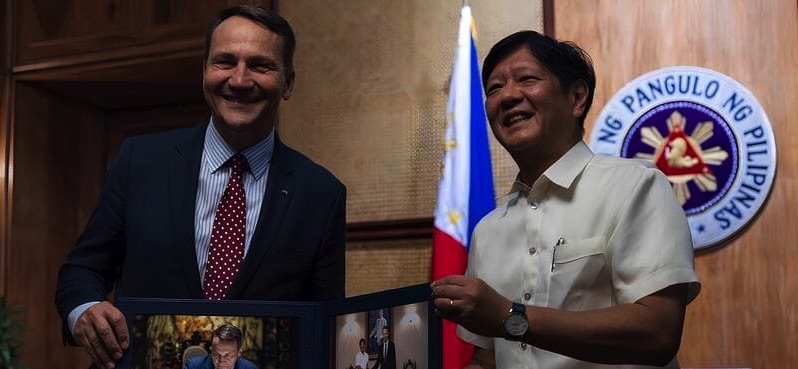
Image Credit: gov.pl (Meeting of the Polish Minister of Foreign Affairs, Radosław Sikorski, with the President of the Philippines, Ferdinand Marcos Jr., in Manila, in September 2024).