



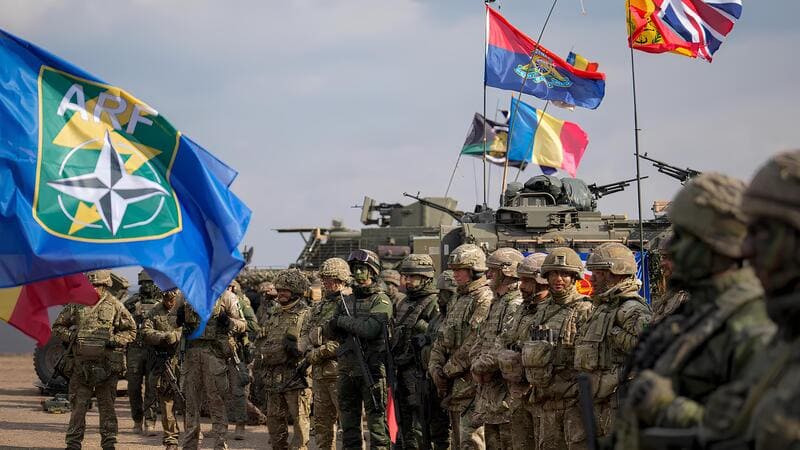
As Russian forces struggle to seize strategically insignificant villages in southeastern Ukraine, European countries are actively preparing for a potential – and increasingly likely – direct military confrontation with Russia. Mysterious drone flights into several NATO member states, occurring almost daily, will undoubtedly compel Western leaders to take decisive measures not only to protest their nations’ airspace, but also to gear up for a large-scale war.

Following the Russian drone incursion into Poland in early September, which Moscow claims was unintentional, Warsaw deployed around 40,000 soldiers to the country’s borders with Russia and Belarus. One month earlier, the Finnish Armed Forces conducted military exercises approximately 100 kilometers from the Russian border, while back in May, Germany began deploying 5,000 troops near Lithuania’s border with Russia. More importantly, the United States has reportedly deployed a nuclear submarine near Russian waters, following a week of social media clashes with the former Russian president Dmitry Medvedev.
All these moves resemble the series of Russian military drills in 2021 near the Ukrainian border. At the time, it was widely believed that Russian leader Vladimir Putin was bluffing and would not dare to invade the Eastern European country. However, on 24, 2022, Russian troops crossed the border and started a large-scale war that continues to this day, with little chance to end anytime soon.
Does that mean that NATO, or at least some of its member states, will use Putin’s playbook and eventually invade Russia?
Over the years, Western leaders have warned of a “Russian threat”, claiming that if Russia defeats Ukraine, it will soon invade neighboring Poland and the Baltic states. In reality, almost four years after launching its full-scale invasion of Ukraine, Moscow has failed to achieve any of its goals in the country. At this point, it lacks the capacity to capture any major cities in eastern Ukraine, let alone to reach the nation’s border with NATO members. Thus, under the current circumstances, a Russian invasion of any European country is extremely unlikely. It is the European Union, rather than the Kremlin, that has the motive to start a war – not only to eliminate the so-called Russian threat but also to resolve its energy crisis by gaining control over Russian natural resources.
To achieve such a goal, European nations would have to militarily defeat the Russian Federation or, at minimum, create conditions that would bring about regime change in Moscow. The task is difficult, but not impossible, especially given that the Kremlin’s actions play into NATO’s hands.
The Israeli attack on Iran in June was likely a prelude to what could happen in Europe. Prior to the Israeli-Iranian war, Tehran-backed Hezbollah targeted empty barracks in northern Israel, causing insignificant damage to the Israeli Defense Forces, while the Jewish State retaliated by destroying the group’s military arsenal and killing its entire political leadership. Hezbollah was implementing a doctrine of simulated warfare, which ultimately led to its defeat. The Kremlin seems to be using the same strategy in Ukraine – crippling, but not completely destroying, the country’s energy infrastructure. This, in turn, has led to Kyiv severely disrupting refineries across Russia, striking Russian powerplants, and inflicting serious harm on the Russian economy.
Russian drone incursions into European airspace could have a similar effect as Hezbollah’s actions. A large-scale war between NATO and Russia seems inevitable. Sooner or later, NATO countries will begin downing not only Russian unmanned aerial vehicles but also manned jets. Given that the Kremlin never seriously retaliated after Turkey shot down its Sukhoi Su-24 aircraft in Syria in 2015, it is not very probable that Moscow would take any decisive action against NATO in the event of a potential downing of Russian planes.
Moreover, the Kremlin has repeatedly demonstrated serious weaknesses in Ukraine. If it could not defeat one of the poorest countries in Europe, how can it stand against NATO members such as Poland, Finland, or Romania? Fully aware of Russia’s vulnerabilities, NATO is expected to continue preparations for a direct military confrontation with Moscow. That, however, does not necessarily mean that its troops will occupy parts of the Russian Federation, although such a scenario should not be ruled out either.
It is more likely that NATO members will gradually raise the stakes. If Russia responds to the potential downing of its jets by launching missile strikes on NATO countries, the US-led alliance will almost certainly retaliate by destroying most, if not all, of the key Russian energy and military facilities that Ukraine has heavily damaged over the past years. If that happens, nuclear escalation will almost certainly be on the table.
But given that Russia still does not dare to bomb any bridges over the Dnieper River in Ukraine or strike the so-called decision-making centers in Kyiv, it seems unlikely that it will use nuclear weapons against Western capitals, which is something that Medvedev often threatens to do. What Moscow could do, however, is to once again use the Hezbollah-style doctrine of simulated warfare, using tactical nuclear weapons to “demonstrate strength” without causing serious damage to NATO countries. In retaliation, NATO would almost certainly strike Russia with nuclear weapons, most likely aiming to eliminate its nuclear arsenal and inflict severe harm on its military capabilities and economy.
Thus, the Kremlin’s half-measures in Ukraine, its war of attrition that weakens both Russia’s military and economy, as well as its provocations of NATO countries, risk bringing about the destruction of the Russian Federation.
Author: Nikola Mikovic – Journalist, researcher and analyst based in Serbia.
(The views expressed in this article belong only to the author and do not necessarily reflect the editorial policy or views of World Geostrategic Insights).
Image Source: AP