



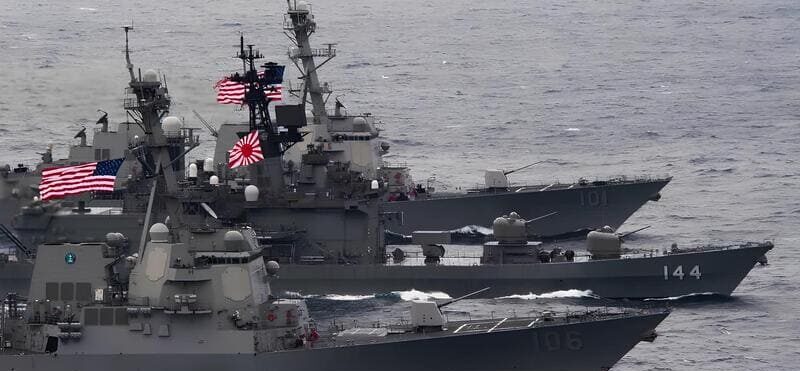
In an age of American retrenchment and Chinese assertiveness, Tokyo must become Washington’s essential partner—or risk facing Beijing alone.
In the opening passages of The Book of Five Rings, the legendary swordsman Miyamoto Musashi wrote that victory belongs not to the strongest warrior, but to the one who understands the terrain, anticipates his opponent’s moves, and positions himself where he cannot be defeated. “Do nothing which is of no use,” Musashi counseled.

For Japan in 2025, this ancient wisdom offers a modern strategic imperative: become so valuable to the United States that Washington cannot pursue its Indo-Pacific objectives without Tokyo.
The question is no longer whether Japan should maintain its alliance with America—that debate ended decades ago. The question now is how Japan can make itself indispensable to a United States increasingly focused on its own hemisphere while facing a China that, despite profound domestic fragilities, possesses sufficient economic mass to dominate Asia if left unchecked.
The Fragile Giant
To understand China’s trajectory is to recognize a fundamental paradox. As Susan Shirk argues in China: Fragile Superpower, the Chinese Communist Party’s obsession with domestic control stems from deep insecurity about its own legitimacy. “China’s leaders view their country as more fragile than outsiders do,” Shirk writes, describing a regime that “feels surrounded by threats” and responds with increasing authoritarianism at home and assertiveness abroad.
This fragility has intensified, not diminished, with China’s rise. In her follow-up volume, Overreach: How China Derailed Its Peaceful Rise, Shirk documents how Beijing’s growing power has produced growing paranoia. The party’s legitimacy rests on delivering economic growth and nationalist satisfaction—a dual mandate that becomes harder to fulfill as China’s economy slows and its regional ambitions generate pushback.
Consider China’s current campaign against Japan. Tokyo faces coordinated disinformation operations painting Japanese seafood as radioactive, economic coercion through targeted trade restrictions, and diplomatic pressure over the Senkaku Islands. These tactics mirror Beijing’s playbook against other nations that resist Chinese preferences—from Australia’s wine and barley exports to Lithuania’s semiconductors to the Philippines’ fishing rights in the South China Sea.
Yet these aggressive moves betray weakness, not strength. China’s economy suffers from massive overcapacity, a collapsing real estate sector accounting for roughly 30% of GDP, youth unemployment approaching 20%, and local government debt exceeding $13 trillion. The demographic crisis is equally severe: China’s working-age population has been shrinking since 2012, and the country will lose an estimated 200 million people by 2100. As the Lowy Institute’s 2025 Asia Power Index notes, while China has closed the gap with the United States, its comprehensive power score has plateaued, and its future trajectory is uncertain.
This combination of economic imbalance, demographic decline, and authoritarian brittleness creates what Shirk calls the “dictator’s dilemma.” The party cannot liberalize without risking its grip on power, yet continued repression stifles the innovation China needs to escape its middle-income trap. The result is a regime increasingly likely to lash out—to secure territorial gains, intimidate neighbors, and demonstrate strength abroad to compensate for weakness at home.
Why American Hegemony Serves Japanese Interests
Some in Tokyo may question whether deeper alignment with an increasingly unpredictable America serves Japan’s interests. The Trump administration’s National Security Strategy, released in November 2025, makes clear that Washington’s focus has shifted toward the Western Hemisphere, that allies must shoulder greater defense burdens, and that America will no longer subsidize security arrangements that advantage others at American expense.
Yet the alternatives are far worse. A Chinese-dominated Asia would mean a region organized around Beijing’s authoritarian model, where economic access depends on political compliance, where maritime commons become Beijing’s exclusive domain, and where smaller nations must choose between submission and isolation.
What happens in China will not stay in China. A hegemonic China would export its governance model—the surveillance state, the social credit system, the assumption that individual rights are subordinate to party authority. We see this already in Beijing’s interference operations abroad. Canada’s intelligence service (CSIS) has documented systematic Chinese efforts to influence elections, intimidate diaspora communities, and compromise Canadian institutions. Australia, New Zealand, and several European nations have uncovered similar operations.
Japan, with its robust democracy, free press, and protection of individual rights, would face even more intensive pressure. A dominant China would demand that Tokyo curb criticism of Beijing, limit contact with Taiwan, accept Chinese interpretations of history, and subordinate its economic policies to Chinese preferences. The alternative to American partnership is not strategic autonomy—it is strategic submission.
Moreover, even an “illiberal” American foreign policy as outlined in the Trump administration’s National Security Strategy remains fundamentally different from Chinese Marxist-Leninism with Chinese characteristics. Washington’s transactional approach still operates within frameworks of sovereign equality, reciprocal trade, and alliance consultation. Beijing’s approach assumes hierarchy, with China at the apex and neighbors as tributaries. The United States seeks a balance of power; China seeks hegemony.
As Jennifer Lind argues in her December 2025 Foreign Affairs article, “The Multipolar Mirage,” the world remains bipolar—only the United States and China exceed the thresholds for great power status. This bipolarity means, as Lind notes, that “peripheries disappear” and countries will be forced to choose sides. For Japan, the choice is clear. The question is how to make that choice strategic rather than reactive.
Musashi’s Strategy: Three Paths to Indispensability
Musashi taught that the master swordsman must excel across multiple dimensions—technique, timing, positioning, and spirit. Similarly, Japan must make itself essential to American strategy across three critical domains: military security, economic security, and technology.
Military Security: The Cornerstone of Deterrence
Japan must transform itself from a capable regional military power into America’s indispensable Indo-Pacific partner. This means three concrete initiatives.
First, Japan should lead in implementing the Trump administration’s “Hague Commitment” requiring NATO allies to spend 5% of GDP on defense—even though Japan is not a NATO member. Current Japanese defense spending stands at approximately 1.7% of GDP, with plans to reach 2% by 2027. Japan should announce a target of 3.5-4% by 2030, demonstrating that it takes regional security seriously and reducing American burden-sharing demands.
This increased spending should focus on capabilities that complement U.S. strengths while filling critical gaps. Japan should expand its submarine fleet from 22 to 30 boats, making it the world’s third-largest submarine force and complicating any Chinese attempt to achieve sea control. Tokyo should also invest heavily in anti-ship missiles, mines, and coastal defense systems that would make any Chinese amphibious operation prohibitively costly. The goal is not to match China’s People’s Liberation Army ship-for-ship but to create what military strategists call “anti-access/area denial” capabilities that make Japanese territory indefensible.
Second, Japan must offer the United States expanded basing and access rights throughout the archipelago, positioning itself as the anchor of America’s First Island Chain strategy. The Trump National Security Strategy explicitly prioritizes “greater access to ports and other facilities” from allies. Japan should preemptively offer to host additional U.S. forces, expand joint training facilities, and pre-position equipment—making it easier for Washington to project power in a crisis and more costly to withdraw.
Third, Japan should take the lead in coordinating multilateral defense cooperation among America’s Indo-Pacific allies. The Quad (Australia, India, Japan, United States) provides one framework; Japan should expand this to include regular defense ministerial meetings with South Korea, the Philippines, and potentially Taiwan (represented by unofficial delegations). The goal is to create a network so integrated that American withdrawal becomes operationally and politically impossible.
Economic Security: The Foundation of Prosperity
Japan possesses the world’s third-largest economy (fourth by some measures, after Germany), sophisticated manufacturing, and deep technological expertise. These assets make Japan essential to American economic strategy—if deployed correctly.
First, Japan should align its trade and investment policies explicitly with U.S. priorities in the Western Hemisphere. The Trump National Security Strategy emphasizes “a Trump Corollary to the Monroe Doctrine” aimed at reducing Chinese economic influence in Latin America. Japan should partner with the United States in infrastructure financing, critical mineral development, and technology transfer throughout the Americas—offering an alternative to Chinese Belt and Road Initiative projects.
This means Japanese companies should prioritize investment in Mexican manufacturing, Colombian copper mining, Chilean lithium extraction, and Peruvian rare earth deposits. Japan’s experience with large-scale infrastructure projects, combined with its reputation for quality and transparency, positions it to help Washington achieve its hemispheric objectives while securing Japanese access to critical materials.
Second, Japan must work with the United States to restructure global supply chains, reducing dependence on China in critical sectors. The Trump administration has identified supply chain security as a core priority; Japan should lead allied efforts to relocate semiconductor manufacturing, pharmaceutical production, and rare earth processing to trusted countries. Tokyo should offer subsidies matching those of the U.S. CHIPS Act, coordinate with Washington on export controls, and create joint U.S.-Japan investment funds for strategic industries in Southeast Asia and the Pacific.
Third, Japan should champion a “Prosperity Network” linking the United States, Japan, South Korea, Australia, India, and ASEAN countries into an integrated economic bloc. This network would harmonize standards, reduce barriers to intra-group trade, and coordinate responses to Chinese economic coercion. When Beijing bans Australian coal or Japanese seafood, member states would redirect trade to network partners, denying China the leverage it seeks.
Technology: The Frontier of Competition
The Trump National Security Strategy declares that “we want to ensure that U.S. technology and U.S. standards—particularly in AI, biotech, and quantum computing—drive the world forward.” Japan must become America’s essential partner in winning this technological competition.
First, Japan should fully integrate its technology sector with America’s, creating a seamless U.S.-Japan innovation ecosystem. This means removing barriers to bilateral technology investment, establishing joint research facilities, and creating fast-track visa programs for researchers and engineers. Japan’s strengths in robotics, materials science, and precision manufacturing complement American advantages in software, artificial intelligence, and biotechnology.
Consider semiconductors: while Taiwan dominates production, Japan leads in critical inputs—photoresists, silicon wafers, and precision equipment. Japan should expand this role, ensuring that no advanced chip can be manufactured without Japanese materials or equipment. This makes Japan indispensable to American efforts to maintain technological superiority while denying China access to cutting-edge capabilities.
Second, Japan should lead in developing dual-use technologies with both commercial and military applications. Autonomous systems, hypersonic propulsion, directed energy weapons, quantum communications—these are areas where Japanese engineering excellence can provide decisive advantages. Tokyo should create a DARPA-equivalent organization focused specifically on dual-use innovation, funded at $5-10 billion annually and coordinated closely with American defense research agencies.
Third, Japan must join the United States in aggressive technology denial to China. This means strictly enforcing export controls, restricting university partnerships in sensitive fields, and screening Chinese investment in Japanese technology firms. Japan has been more reluctant than the United States to decouple from China technologically; this must change. Every chip, every algorithm, every breakthrough that reaches Beijing makes future conflict more likely and more costly.
The Costs of Indispensability
None of this will be easy or cheap. Raising defense spending to 4% of GDP means an additional $150-200 billion over five years. Restructuring supply chains will create short-term disruptions. Confronting China economically will invite retaliation.
Yet these costs pale compared to the alternative. Japan’s security environment has deteriorated dramatically over the past decade. China conducts nearly daily incursions near the Senkaku Islands. North Korea fires missiles over Japanese territory. Russia has expanded cooperation with both Beijing and Pyongyang. The 2025 Lowy Institute Asia Power Index shows China’s diplomatic influence at an all-time high, with many Southeast Asian nations hedging their bets rather than clearly aligning with Washington.
In this environment, Japan cannot afford to be merely a capable ally. It must become an indispensable one—so valuable to American strategy that Washington’s Indo-Pacific presence becomes not just preferable but necessary to achieving core American interests.
The Way Forward
Musashi concluded The Book of Five Rings with the “Book of the Void,” teaching that true strategy transcends technique to achieve a state where victory is inevitable because defeat has become impossible. For Japan, this means creating strategic conditions where America cannot abandon the Indo-Pacific without abandoning its own core interests, where Chinese hegemony becomes impossible because the costs exceed any conceivable benefits, and where Japan’s security is guaranteed not by promises but by structural integration.
This requires clear-eyed realism about both partners. The United States under any administration will prioritize American interests; Japan must align those interests with its own. China will not collapse, but neither will it peacefully integrate into a rules-based order; Japan must help contain Chinese ambitions while managing the relationship to avoid catastrophic conflict.
The path to security in the 21st century runs through Washington, not Beijing. But walking that path requires Japan to transform itself from America’s loyal ally into America’s essential partner—indispensable to U.S. strategy, irreplaceable in U.S. calculations, and so deeply integrated into American interests that Tokyo’s security becomes inseparable from Washington’s success.
This is not subordination but strategy. Not weakness but wisdom. As Musashi knew, the warrior who positions himself correctly need not fear any opponent, however large. Japan must apply this ancient insight to modern statecraft—and ensure that its indispensability guarantees its security for generations to come.
Author: Stephen R. Nagy – Professor of Politics and International Studies at the International Christian University, specializing in Indo-Pacific geopolitics and great power competition. Concurrently, he holds strategic appointments as a Senior Fellow and China Project lead at the MacDonald Laurier Institute (MLI) and the Asia-Pacific Foundation (APF), and a Visiting Fellow at the Japan Institute for International Affairs (JIIA). He serves as the director of policy studies for the Yokosuka Council of Asia Pacific Studies (YCAPS), spearheading their Indo-Pacific Policy Dialogue series. He is currently working on middle-power approaches to great-power competition in the Indo-Pacific. The title of his forthcoming book is “Japan as a Middle Power State: Navigating Ideological and Systemic Divides.”
(The views expressed in this article belong only to the author and do not necessarily reflect the views of World Geostrategic Insights).
Image Source: U.S. Navy photo.