



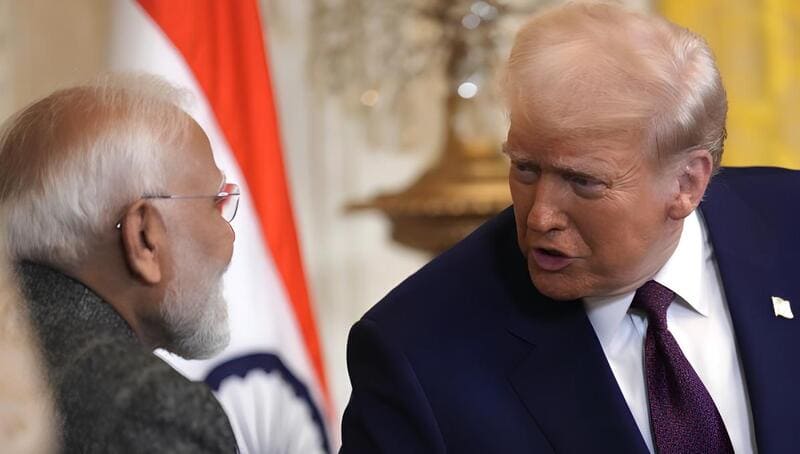
By following the famous quote “There are no permanent friends or enemies in International Relations but the permanent Interests”, Global politics has witnessed that the relationships between states are surely based on their national interests.

The shifting of alliances, new relationships, treaties, political romance, high-ranked visits, security, economic as well as trades bilateral agreements all are based on the state’s national interests. Owing to the rapidly changing of geopolitics, geoeconomics and now digitalization in international relations, states priorities have been changed in this contemporary realpolitik. As compared to cold war politics, this era is more complex and interests oriented.
The cold war politics was based on only two blocs, USA vs USSR but the post-cold war era is the era of multipolar world. The rise of China, the biggest Indian market, the economic rise of Brazil and active participation in international and regional blocs, the rapidly economic rise of East Asian nations, the shifting of geopolitics from Oil-thrones to AI-crowns, the Artificial intelligence marathon, weakening position of Europe at international politics theater are the Realtime changing in global politics.
Moving ahead, after the closure of WORLD WAR II, the global order polarized into two blocs named communist and capitalist led by the USSR and USA respectively. The cold war era was the diplomatic or ideological rift midst USA and USSR to strengthen their capitalist democracy and communist authoritarianism one-to-one. Soon after the W.W.II and the subsequent deterioration of colonialism, the states got independence and emerged as independent nations.
Following the decolonization and the prolonged political rift, the sub-continent alienated into independent states including Pakistan and India. The formation of NATO, SEATO, CENTO (Baghdad Pact) was the USA led defense alliance blocs with the aim to counter the expansion of communist authoritarianism led by the USSR. On the contrary, WARSAW PACT led by USSR with the juxtaposition of eastern Europe nations to thwart the growth of USA inspiration.
During the Cold war, India didn’t join any bloc and was the biggest follower of NAM (non-alignment movement) led by Jawaharlal Nehru, Josip Broz Tito, Sukarno, Gamal Abdel Nasser and Kwame Nkrumah. The relationship between India and the USA was the tale of love-hate opinions during the entire period of the Cold war. Indian premiers asserted that USA supported Pakistan against Indian national interests, particularly Pakistan-India wars. On the contrary, Indian treaty with USSR named “Indo-Soviet Treaty of Peace, Friendship and Cooperation” in the year of 1971, Indian movement towards Nuclear program and nuclear explosion “Smiling Buddha” of 1974, Indian support to Bangladesh liberation war and east Pakistan, USA led USS enterprise at Bay of Bengal, support to Pakistan during 1971 war, Pakistan-China-USA diplomatic hugging and Ping-Pong diplomacy midst USA and China with the help of Pakistan were the major moves behind the in-depth estrangement between two democracies.
The era from 1980 to 1990 was the era of ambivalent India-USA partnership. After the USSR invasion of Afghanistan in 1979, Pakistan became the sole frontline USA ally in South Asia to counter the USSR. Pakistan received high-level support form Jimmy Carter and Ronald Reagan administrations respectively aimed to thwart USSR expansion but reciprocally the rising pro-soviet Indian foreign policy made rift between Indira Gandhi administration and Ronald Reagan administration. The Operation Blue Star led by Indira followed the undesirable image of India in the west. The recalling of the Indian government after Indira’s assassination and Rajiv Gandhi’s foreign policy moved India close to the USA. In addition, the dissolution of the USSR, American interests in India began to increase and set a new era of engaged relationship.
Owing to Indian biggest market, economic growth, liberal economy, democratic values, strategic location, near to Indian Ocean and SLOCs, India became the high priority list in the USA foreign policy towards South Asia in post-cold war epoch. The rise of China on the international stage increased the importance of India in the 21st century. During Clinton and G.W. Bush era, the relationship between India and the United States marked unprecedented growth.
The Next Steps in Strategic Partnership (NSSP) 2004, Defense framework 2005, civil nuclear deal 2008 were the unbeatable success tale of two democracies. The continue twice official visits of B. Obama to India and signed defense trade and technology initiative (DTTI), declaration of India as Defense partner, the security agreements named LEMOA, COMCASA, BECA and ISA between India and the USA made India the most trustworthy and counterweight power against any anti-American power in wider South Asia and Asian region respectively. During trump first presidency and his remarked “India, Indians and PM Modi” as well as “We love you. We love you, India, very much” contributed significant solidification of friendly rendezvous amongst the two nations.
Although the first Trump’s presidency was characterized by friendly relations between India and the United States, there is declining trust in Trump 2.0. This growing divergence is the result of complex geopolitical changes, policy adjustments, and a sense of misalignment in their overarching strategic outlook. The perception is growing in American strategic circles that India has not satisfied Washington’s expectations as a reliable counterweight to China in the Indo-Pacific region.
Between the years 2000 and 2020, Washington made a robust, if still limited, investment in India’s rise, viewed as favourable to the larger goal of containing China’s regional assertiveness, both diplomatically and militarily. Even while India has increased its purchasing of advanced American weaponry, there are growing concerns in Washington that it deliberately maintains and deepens economic and trade ties with China. While Washington increasingly interprets this as a hypocritical strategy. While also approaching China economically, India interprets this approach simply as the national interest of a country within a multipolar world.
To add to complexity, India is becoming more engaged with Iran. New Delhi has continued to invest in connectivity and infrastructure projects, exemplified in its hosting of a proposed India–Middle East–Europe Economic Corridor (IMEC). In line with the United States’ hardline posture against Iran, India’s active partnership with Tehran creates unease. From Washington’s perspective, it is concerning to see a key partner begin deepening ties with a state the United States mostly considers to be a strategic adversary. India, on the other hand, frames its engagement as supporting energy security, facilitating regional connectivity, and supporting its strategic autonomy.
Moreover, the influence of the Indian diaspora in the United States has become more pronounced in this context, especially in its involvement in discourses related to US foreign policy toward South Asia. Notably, while the diaspora has historically added to the strength of bilateral relations, there are increasing concerns in Washington that the diaspora’s organized lobbying efforts could pull US policies away from US strategic imperatives. That concern is heightened by the various visa limitations—above all the B-1 visa limitations—that disproportionately impact Indian nationals.
Furthermore, even though India is officially participating in U.S.-led regional initiatives, such as Quad, AUKUS, and the Blue Dot Network, American officials are increasingly frustrated that India will not be able to provide a more robust contribution. Countering China is central to these initiatives, but India’s hesitance—which has stemmed from its historical doctrine of non-alignment and desire for strategic autonomy—has limited India’s operational contributions. The U.S. was hopeful for a more forceful and overt operation by India to counter China in regional avenues such as maritime security and infrastructure development. To further exacerbate this context, Washington has recently shifted its strategic approach towards Pakistan.
Despite growing hostilities in the Middle East and the Iran–Israel conflict, there have been many changes in U.S. strategic considerations based on Pakistan’s geographical proximity to Iran, nuclear capabilities as an Islamic republic, and importance in the historical context of regional security. Trump has suggested even more favourable views towards Pakistan, especially as a stabilizing actor, but at least maintaining Pakistan’s geo-political presence as a counter-actor towards Iran or world-wide coalitions of predominantly Muslims attracted to rivals like Russia or China and their agendas. The redeployment of intelligence and surveillance assets in Afghanistan and Central Asia also serves this broader strategy of keeping a close watch on Iran’s happenings and China’s BRI enlargement in the region.
India continues to pursue a foreign policy premised on multi-alignment in a less complicated environment. It engages the U.S. for technology, defense, and diplomatic cooperation, while sustaining its economic and energy relationships with China and Iran and also relying on Russia for important defense needs. This strategy enables India to avoid becoming overly beholden to any one power—although it makes executing the type of security expectations desired by partners like the U.S. less simple. It has led to a growing view in Washington that India remains constrained in its ability to act as a fully dependent partner—valuable but consistently unreliable as part of a shared security framework. Going forward, the way India and the U.S. will develop their relationship is largely contingent on political developments in the respective nations.
In India, the direction of foreign policy will be determined the next year, when general elections will be conducted and the new government is instated, though the challenge will be significant for any incoming leader. Still, the U.S. decision-makers realize that solving for the option of abandoning India altogether would be a poor strategic framework—though, this official acknowledgment is not going to accelerate interest in adopting shared security frameworks with India. Given India’s vast consumer market, growing technological capacity, and critical location near the Indian Ocean and Western Pacific, it remains central to the broader USA Indo-Pacific strategy.
As the famous geopolitical maxim goes, if America is your enemy, you’re in danger—but if it’s your ally, you should be even more cautious. In the words of Henry Kissinger, the United States has no permanent friends or enemies, only permanent interests. While there may currently be a pause or cooling-off in relations, the structural logic of India–U.S. cooperation remains intact. Both countries understand that despite divergences, their strategic partnership—however difficult—cannot be easily abandoned, especially as great power competition intensifies across the Indo-Pacific.
Author: Rana Danish Nisar – Independent international analyst of security, defense, military, contemporary warfare and digital-international relations.
(The views expressed in this article belong only to the author and do not necessarily reflect the views of World Geostrategic Insights).
Image Source: AP