



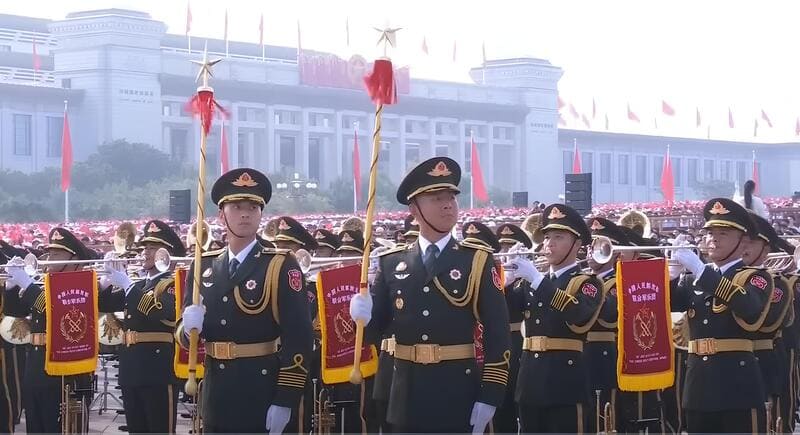
The 2025 China Victory Day Parade in Beijing’s Tiananmen Square flexes an imposing display of hard power against its imminent rivals, the United States and the West, cruising a demand of global respect to fortify a new world order of multipolarity.

The last time China quenched for magna potentia revealed advanced artillery and skilled heavy cavalry in the early years of the Qing dynasty when it stood for commanding heights with European contemporaries that clinched the Mongolian rule.
The September 3 commemoration of the 80th anniversary of the Second Sino-Japanese War and World War II posed a sheer political theater elevating China’s astute rejuvenation of superpotestas, a march of its growing military competences. An imperium Asian power turns around to display advanced weapons of anti-ship missiles, undersea drones, air-defense lasers, and robot wolves to the world flanked by Russian and North Korean authoritarian dictators.
Today, the world is upset with bipolarity. In the past, the axis of power exuded by multipolarity in world affairs dominated after the Napoleonic Wars pushed for the Concert of Europe, often considered a classic portrait of a multipolar system. The balance of power polished slices of greed from Britain, France, Austria, Prussia, and Russia in those turbulent eras. Currently, the frame of multipolarity derives with the resurgence of China, India, Russia, and the EU in a defiant push to destroy the US-led unipolar world order.
Wearing a gray Mao suit to connect the current leadership with the nation’s revolutionary past, Chinese President Xi Jinping’s powerful performative politics shown in an open-topped black limousine, honored China’s critical role in the last world war as he traveled along Chang’an Avenue and reviewed the long formations of his snappy military personnel as the paramount leader shouted repetitively, “Comrades, you are working hard,” and in unison the troops roared in concerted robotic reprise, “We serve the people”.
The pompous 2008 Beijing Olympics was a grand showcase of China’s tangible economic achievements yet unwanted soft power to the world, besting other host nations for any Olympic Openings in the 21st century. The next chapter unveiled in the 2025 Tiananmen Military Parade has raised China’s positionality as an alternative global leader projecting a vision of a new international order framed on two-fold choices between “peace or war and dialogue or confrontation”.
China’s reinvention of events and counternarratives downplayed Chiang Kai-shek’s Kuomintang and the National Revolutionary Army’s primordial efforts to defeat Japanese forces. It also stripped the United States’ biggest role as one of the main players in the commemorative event. After WWII, the Republic of China received international recognition as one of the “Big Four” allies and became a founding member of the United Nations Security Council.
Smaller forces from Eighth Route Army and New Fourth Army commanded by Mao Zedong and the Chinese Communist Party fought guerilla warfare in northern China while tying down Japanese troops and expanding Communist influence in the countryside. Their resistance allowed them to gain legitimacy and strength when Tokyo surrendered after Washington dropped atomic bombs to Hiroshima and Nagasaki and the Soviet Union invaded Manchuria. After the war, the Chinese Communists in Mainland used the wartime gains to eventually defeat the Chinese Nationalists in Taiwan cum China’s Civil War leading to the rise of the People’s Republic of China.
The grand military parade magnified China’s maximum credible defense posture as it now possesses multifaceted military deterrence across land, sea, air, cyber, and space domains. The imposing triumvirate of Beijing, Pyongyang, and Moscow paves way to a projected narrative of China’s global leadership with advanced weapons and modernizing military toward a distorted polarity with the US while asserting a dominant role in a decaying world order. While Beijing may have the technology, Washington still has the edge following a bottom-up strategic culture that binds units on the ground which can make decisions to remain agile in present and future combat.
However, the August 11 Chinese warships’ collision inside the Philippines’ Exclusive Economic Zone drew dissension worldwide despite Beijing’s colossal armada in its risky maneuvers and unlawful voyages. Given military might, the People’s Liberation Army-Navy (PLA-N) and Chinese Coast Guard (CCG) are expectedly to exercise more coercive gray-zone pressure in the Philippines. Beijing would build island bases as force multipliers for its maritime militia and PLA to watch, refuel, and surge faster inside the South China Sea. Bigger militia footprints tied up to PLA-N’s anti-access strategy may thicken the revitalization of undersea and nuclear deterrent maturation while China can surveil and surge faster than any rival due to its fortified outposts.
As a strategic foresight, the plight of China’s wider Indo-Pacific positioning will not be as smooth sailing despite possession of larger destroyers, cruisers, carriers, and long-range missiles. The combined interoperability and mobility of networked-alliance and middle power coalition in the region will raise risk for Beijing’s nesting ambition in the Indo-Pacific. Blatant use of China’s salami-slicing would not trigger a theater-wide open war, but a protracted gray-zone occurrence remains existential as Beijing becomes a volatile agent in navigating South China Sea’s prospective peaceful survival.
As the world steps into an interregnum, multipolarity of regional powers will lord different corners of the map. China’s power may glow in some areas while being constrained in others until it becomes a hegemon, either regionally or globally. The United States will assert a unipolar or bipolar worldview, vestiges from the Cold War era and current state of denial syndrome, but a US-centric liberal world order will evolve aimed at altering current hierarchy of powers and reforms are made inclusive to contending great powers.
In a future flatter hierarchy, the US would still be a central player with a less commanding role, showing post-hegemonic syndrome of liberal internationalism 3.0 that is cognizant of post-Westphalian sovereignty. In the end, the spell of ‘The Lord of the Rings’ amuses world leaders — even the purest intent can become evil but small deeds keep darkness at bay.
Author: Dr. Chester Cabalza – Founding President of the Manila-based think tank International Development and Security Cooperation (IDSC).
(The views expressed in this article belong to the author and do not necessarily reflect the views of World Geostrategic Insights).