



Today, four names dominate the global discussion and everything seems to be reduced to them: Russia, China, the United States, and Europe.

The Middle East, Africa, and other regions appear sporadically, but it is within this — admittedly incomplete — framework that most debates unfold. We are left wondering whether what is underway is an imminent collapse or a profound structural reordering — strategic, economic, cultural, and military — advancing faster than the decision-making capacity of most political leaders.
What many interpret as chaos is, in reality, competition between systems: systems of power, values, decision-making, and resilience. On this global chessboard, all actors seek to play by their own rules and pursue their national interests. China plays the long game, avoids emotional escalation, and bets on silent dominance through economics, technology, and patience. Russia plays disruptively and uses military force as a political language, accepting levels of pain the West does not tolerate. The United States attempts to manage the system, balancing deterrence with domestic politics, hesitating when allies hesitate.
Ukraine sits within this triangle but does not control it. And Europe, despite its rhetoric, has yet to become a fully-fledged strategic actor; it is more often part of the board on which others play. The reality is that Europe is still unprepared for a serious escalation — militarily, psychologically, and culturally.
The future battlefield may not even be Europe itself, but Africa — currently treated as a peripheral element of global geopolitics, yet increasingly central due to critical resources, energy routes, demographic growth, and profound institutional fragility. These factors fuel the appetite for what may well be the true strategic prize of the coming decades. This is why China invests quietly, Russia destabilizes selectively, Turkey expands its influence, and the West hesitates. And in geopolitics, hesitation creates vacuums — and vacuums attract predators.
Many strategic errors stem from a failure to understand different cultures. Terrorism rooted in radical Islam cannot be viewed through the lens of Christian naïveté. Putin cannot be interpreted in the same way as Zelensky. Russia cannot be read through Western emotional logic, nor China through democratic criteria. And Europe cannot be understood without acknowledging its culture of comfort and internal fragmentation. This is where miscalculations arise — and it is always populations who pay the price.
Each country pays for its strategy in a different currency: money, energy, legitimacy, blood, or future dependency. Energy and supply chains are not economic issues; they are strategic vectors. The uncomfortable truth is simple: values do not defend themselves. History shows that societies which avoid sacrifice, confrontation, and responsibility eventually outsource their security.
Europe’s problem is not a lack of information. It is a lack of political and psychological will. Leadership today requires telling uncomfortable truths, preparing citizens for real risks, and accepting costs. Avoiding difficult decisions is not morality; it is deferred collapse. Who in Europe is prepared to be that voice?
Consider the recent statements by Mark Rutte in Berlin, delivered not merely as a political address to NATO allies but as a strategic warning to the West. It was the clearest and most explicit statement by a NATO Secretary General in decades that the United States can no longer be treated as a stable and predictable guarantor of European security. He did not say this outright, but every line of the speech carried that structural implication.
Rutte signaled that NATO intelligence and European defense ministries now assess a high probability of a Russian attack on NATO territory within a five-year window. This is a classified estimate now widely shared within several European defense ministries. Rutte chose to say it publicly because European public opinion is not yet psychologically aligned with the scale of the threat.
According to NATO and Western military and intelligence officials, there have been over 1.1 million Russian casualties since the start of war in 2022, and this year Russia has lost an average of 1,200 troops a day, while it still continues to expand its military industry and recruitment. The message is clear: a state willing to sacrifice a million lives is also willing to cross borders. Europe now understands that it must rearm without assuming U.S. reliability. Rutte never said “we cannot rely on America,” but he came as close as diplomatic language allows. The unspoken reality was finally spoken aloud: Europe is preparing for the possibility that the United States may be politically paralyzed or strategically absent at the decisive moment.
German Chancellor Merz recently echoed this message, stating clearly: “The decades of Pax Americana are over for us in Europe, and for us in Germany as well. It no longer exists as we knew it. The Americans are now defending their own interests very, very aggressively. And that can only mean one thing: we must defend ours too.”
The language being used is not rhetorical. “Mass mobilization,” “millions of displaced people,” “extraordinary losses,” and “destruction reaching every home” are not political phrases — they are civil defense scenarios. NATO leadership only uses such language when preparing societies for structural change: conscription, industrial conversion, compulsory service in defense industries, or wartime taxation. Rutte and Merz are describing a Europe that must relearn how to behave as a continent at war.
The central thesis is that Ukraine’s defeat would trigger the most dangerous period in Europe since 1939. A Russian victory would place a hardened, militarized state directly on NATO’s borders. The cost of supporting Ukraine today is small compared to the cost of defending Poland or the Baltic states tomorrow.
The United States appears unwilling to fully internalize this shift. Washington continues to treat Russia as a regional revisionist actor and China as a global competitor to be managed. This creates a dangerous disconnect. Europe sees a joint adversary fueling a single war machine. The U.S. political system remains divided and frequently distracted — one faction focused on cutting support for Ukraine, another attempting to compartmentalize Beijing and Moscow. The result is an alliance that no longer shares a common threat perception.
The last time a senior transatlantic figure described Europe’s future in these terms was during the Korean War in 1950. The threat picture is now explicit. Ukraine is the buffer keeping the frontline off NATO territory, and the window to prevent a broader conflict is closing.
At the end of this global reordering lies no abstract geopolitical concept. As we are witnessing in this hybrid war, it is an airport, a company, a port, a city — and the ordinary citizen who inherits decisions they never made. This is why security is no longer merely military. It is mindset, prevention, behavioral awareness, and anticipation.
As Ido Kalev, author of The Spy Who Led Me, aptly states: “The world has not become more dangerous; it has become more honest.” Systems built on comfort, predictability, and deferred responsibility are being tested intensely and rapidly. Some will adapt. Others will fracture.
Returning to the nearby example of Ukraine, its tactical innovation is widely acknowledged: asymmetric strikes, drone warfare, naval disruption, and battlefield adaptability have enabled it to resist Russia for nearly four years. Kyiv was expected to fall in four days; instead, nearly four years later, even Pokrovsk had resisted for months. But as taught at military academies, tactics are not strategy. Small, agile capabilities can wear down a giant, but defeating one requires systemic backing.
That backing has been hesitant and at times almost absent. This is why Russia has not collapsed as quickly as expected: the war is existential for Moscow, tolerance for loss is higher, soldiers are reduced to statistics in Kremlin briefings, and political retreat is unacceptable for Putin. Symbolic gestures, media moments, and pre-negotiation provocations may look strong, but they have increased risk for Europe more than for Russia. And is Europe prepared for escalation?
Ukraine’s maritime tactics and strikes on refineries are equally impressive — unmanned systems, precision harassment, asymmetric pressure — but they do not constitute dominance. Russia feels pain, not strategic paralysis, and replaces one sanction with another workaround. Sanctions are not merely economic tools; they are force multipliers, as are civilian energy infrastructures, gas fields, hospitals, and supermarket supply chains.
Russia may be a weak economy, but ideologically it behaves differently from a strong economy with weak cohesion. A sanctioned state with internal discipline can endure longer than a wealthy but fragmented one. Looking only at GDP figures or military inventories helps, but it is insufficient to grasp reality.
The hard truth remains: societies that avoid friction, sacrifice, confrontation, and responsibility ultimately externalize their security. Europe’s problem is fundamentally one of will. Unpopular decisions — the return of conscription, risk acceptance, mental preparation of citizens, and explaining reality without anesthesia — are the true challenges facing European leaders. Security doctrine matters above all as a mindset.
Urban warfare today, as seen in Ukraine, is not merely a military problem. It is a psychological, cultural, and organizational collapse test. Armies train for maneuver, fire superiority, and technological dominance — urban warfare destroys all three. Rules do not restrain the enemy, civilians do not behave rationally, and escalation will not be controlled.
Urban warfare rewards ambiguity, cruelty, patience, and ideological indifference. Hamas mastered this, ISIS practiced it, and much of it may already be dormant within Europe, waiting to be activated.
Adversaries have studied Europe’s structural weaknesses: fragmented political orientation, multiple chains of authority, slow or absent decision-making, restrained rules of engagement, fear of public perception, legal overload, monumental bureaucracy, cultural misreading, and a focus on devices rather than people. Urban adversaries exploit all of these gaps. They do not need to win militarily — only to outlast legitimacy. Some already win democratic elections in the West.
Those who understand adversaries, culture, human behavior, and power dynamics will stay ahead. Those who do not… will react too late.
Some will claim this sounds catastrophic, pessimistic, or militaristic. It is not alarmism; it is prudence. Hoping for the best while preparing for the worst is not cynicism — it is the basic rule of strategic responsibility. History is clear: those who prepare do not cause crises; those who confuse comfort with security do.
And if there is one place where that confusion has become cultural, it is Europe. The European challenge is not choosing between fear and hope, but between lucidity and denial. In a rapidly reorganizing world, Europe will only have a future if it once again takes seriously the word it outsourced for decades — to others who now appear to ignore it: responsibility.
Author: Fernando Figueiredo – Retired Portuguese Army colonel and former NATO professional, who held various strategic leadership positions, currently serving as a defense consultant at Pulsar Development International. His work focuses primarily on defense requirements, offering expertise and a network of contacts that enable operational challenges to be overcome with effective, tailored solutions.
(The opinions expressed in this article belong only to the author and do not necessarily reflect the views of World Geostrategic Insights).
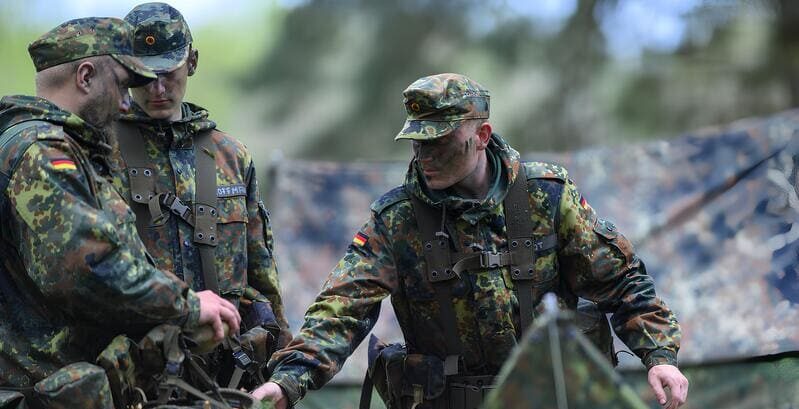
Image Credit: Klaus-Dietmar Gabbert/dpa-Zentralbild/dpa (Recruits from Germany’s Logistics Battalion 171 practice pitching tents at the Burg training area).