



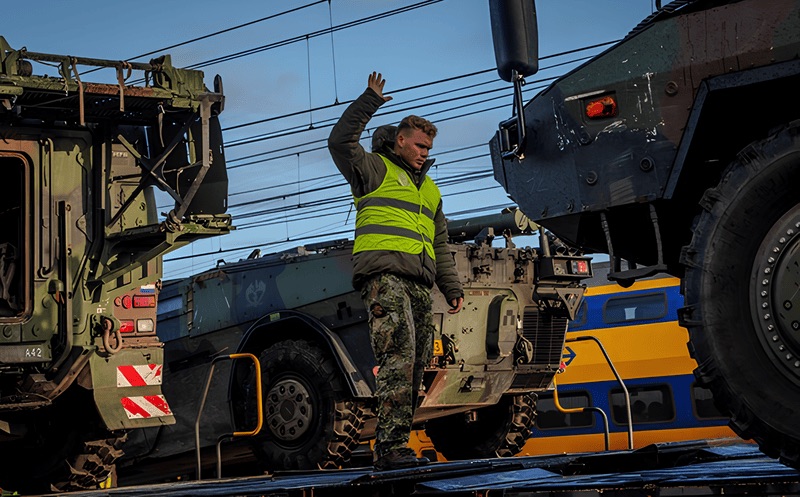
Is it acceptable that, in 2025, reinforcing NATO’s eastern flank could take nearly two weeks, even for a light brigade? Or that transporting a single V-12 diesel engine for a Portuguese Leopard 2 stationed in Slovakia might require almost a month to travel from Santa Margarida to Lešť? This is not an exaggeration. It is the current state of European military mobility.

These limitations frame the significance of the European Commission’s recent announcement of a major initiative to improve military mobility across the continent. The goal is straightforward: make it faster and easier for troops, heavy vehicles and equipment to move between EU member states. Yet the reality is equally clear, Europe is starting this race late, and from a position of structural weakness.
Still, the initiative deserves recognition. With a full-scale war on Europe’s border and growing instability stretching from the Sahel to the Middle East and the South Atlantic, strengthening logistical corridors, adapting infrastructure and improving coordination are essential steps toward greater European resilience. But the core question remains: is Europe acting in time, or merely reacting after the fact? Military preparedness is not a luxury, it is a precondition for credible deterrence. Delay only increases vulnerability.
There is also a political dimension that cannot be ignored. The European Union wants to demonstrate that its security does not depend solely on external guarantees or shifting political winds in Washington. The new measures represent an attempt to translate the long-discussed notion of “strategic autonomy” into practical capability. Yet success will require more than declarations. It demands political will from member states, sustained investment, interoperability among European armed forces and a culture of real burden-sharing—conditions that are far from consistent.
The urgency is well known. Within both NATO and the EU, defence planners have long warned that moving forces across Europe would take weeks due to administrative, logistical and diplomatic bottlenecks. Every cross-border movement requires a chain of national authorisations, equipment must navigate overstretched road and rail networks, and even with specialised customs exemptions, procedures vary widely and often stall in bureaucracy. Despite years of rhetoric about unity and readiness, Europe still lacks an integrated logistical backbone. Without one, its dependence on the United States remains structural.
Railways, whose importance has been underscored daily in Ukraine, are a particular vulnerability. Europe today has fewer kilometres of rail infrastructure than it had after the Second World War. Between 15% and 20% of track has disappeared, and 5% to 10% of the remaining network is saturated, meaning no additional trains can be added without removing others. Differences in gauge, notably in Portugal and Spain, for example, add yet another layer of complexity.
Against this backdrop, European geography becomes more strategically valuable than ever. Let me point out the case of Portugal where is deep-water ports – Sines, Lisbon, Setúbal, Leixões – and its air bases, including Beja, Monte Real, Ovar and Lajes, form a natural system of seaports and airports of debarkation crucial for reception, staging and onward movement of allied forces. Modernising such dual-use infrastructure with EU and NATO co-funding not only strengthens collective defence but also creates economic and regional development opportunities.
The Commission’s proposal for a €17-billion Military Mobility Package, reinforced by the “Military Schengen” initiative unveiled on 19 November, seeks to address these gaps. For the first time, Brussels will assume a coordinating role in military logistics, traditionally a guarded domain of national sovereignty. Yet the European Court of Auditors’ Special Report 04/25 highlights an uncomfortable fact: previous projects were often selected on civilian rather than military priorities, leaving critical gaps untouched.
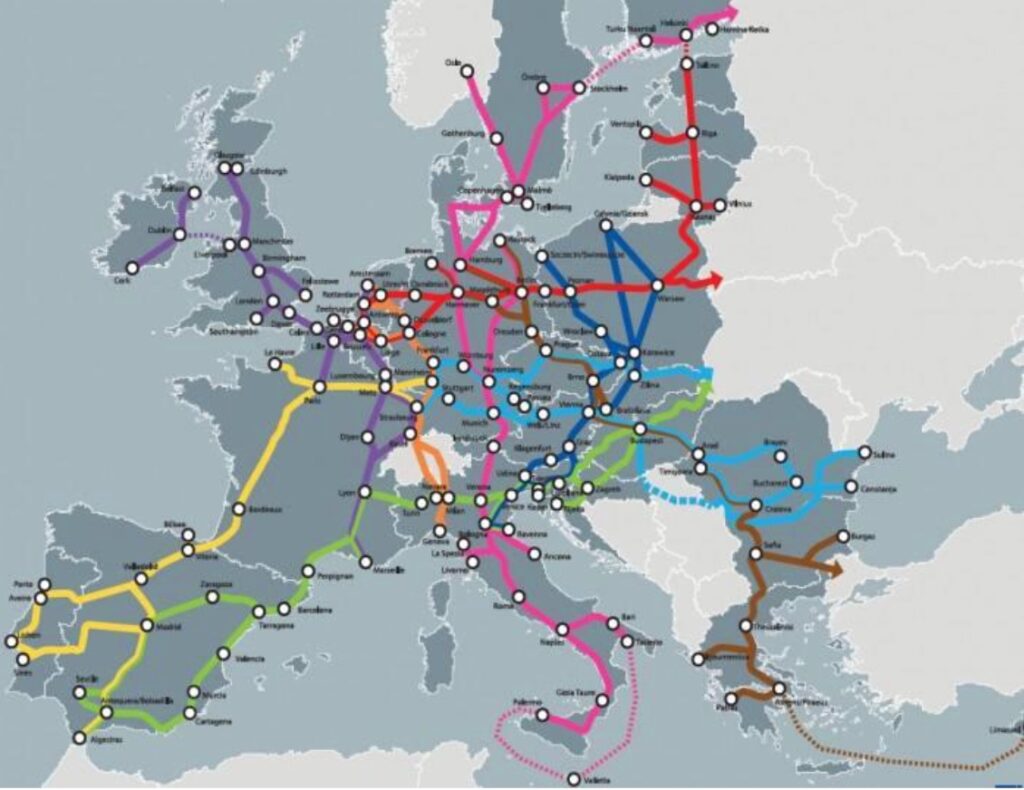
Modern defence, however, demands more than infrastructure. It requires industrial capacity, technological innovation and an integrated civil-military ecosystem – from energy resilience and cybersecurity to autonomous vehicles, sensors, secure communications and maintenance industries. Defence planning must therefore be embedded in territorial planning, regional development programmes and national industrial strategies.
The United States remains the cornerstone of European security, but Washington’s future engagement will increasingly hinge on Europe’s ability to provide credible logistical support and contribute materially to shared defence. Offering strategic ports, transport corridors and sustainable support infrastructure may help keep the transatlantic bond strong, but the signs suggest Europe must also prepare to rely more heavily on itself.
European Military Mobility is thus more than a technical programme. It is a test of Europe’s ability to convert political ambition into operational capability, of its shift from vulnerability to sovereignty. Europe now faces a strategic crossroads: either it consolidates the material foundations of its security, or it risks remaining exposed to external shocks and the slow erosion of its strategic autonomy.
The question is no longer whether Europe needs this transformation. It is whether there is still time to deliver it.
Author: Fernando Figueiredo – Retired Portuguese Army colonel and former NATO professional, who held various strategic leadership positions, currently serving as a defense consultant at Pulsar Development International. His work focuses primarily on defense requirements, offering expertise and a network of contacts that enable operational challenges to be overcome with effective, tailored solutions.
(The opinions expressed in this article belong only to the author and do not necessarily reflect the views of World Geostrategic Insights).
Image Source: EU Commission Website