



The new U.S. National Security Strategy (NSS), released by the White House on December 4, has produced a rare consensus among analysts: regardless of ideological perspective, it is a document that marks a profound rupture with U.S. foreign policy as practiced over the last several decades.

Beyond that, however, agreement evaporates. Interpretations diverge sharply between those who see the document as a dangerous ideological drift inspired by nationalist thought, and those who instead view it as a belated exercise in strategic realism.
Understanding this NSS requires recognising that it operates simultaneously on three levels: as a diagnosis of the international system, as an instrument of political power, and as an ideological manifesto. It is precisely this overlap — the fusion of strategic analysis, partisan agenda-setting, and identity-based narrative — that makes it such a controversial document and so hard to situate within the traditional canon of U.S. foreign policy.
Europe as a Battleground for Ideological Competition
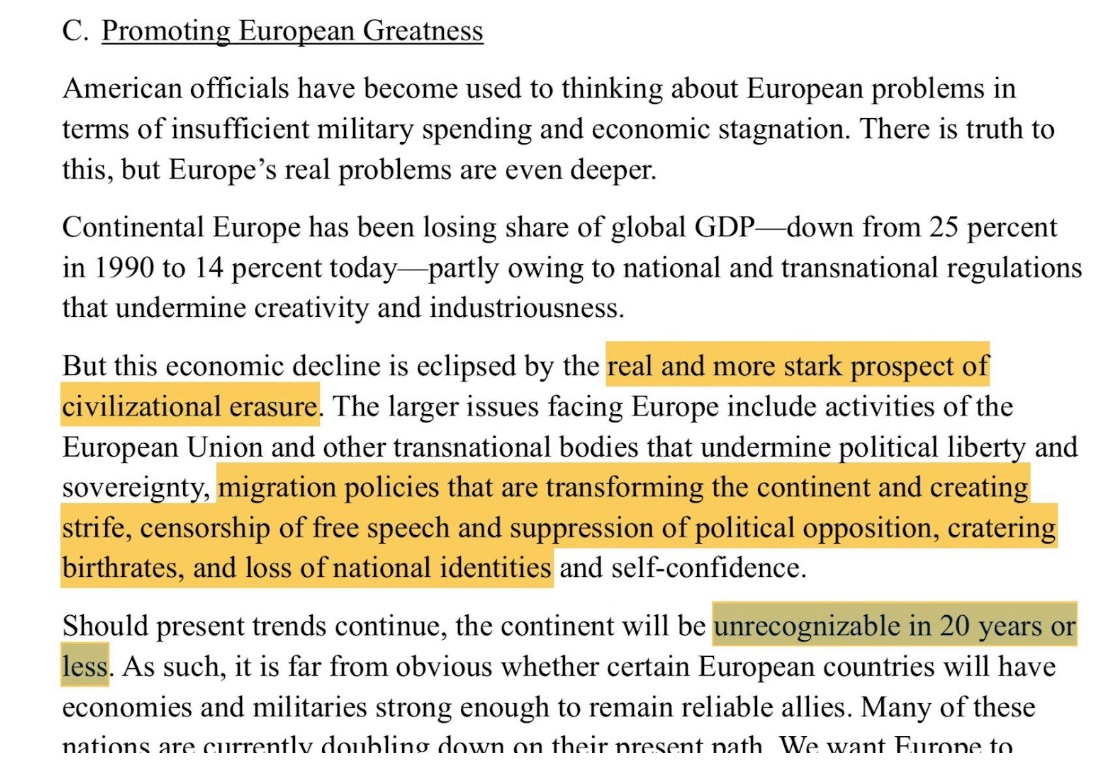
One of the most striking aspects of the new NSS is the way the United States no longer treats Europe as a structural ally but rather as a terrain of internal political competition. The document accuses European governments of “subverting democratic processes” and of failing to pursue peace with Russia, overlooking the fact that an overwhelming majority of European populations remains strongly pro-Ukrainian. Unlike previous U.S. strategic documents, which emphasised shared values and collective responsibility, this NSS adopts rhetoric that echoes European populist discourse.
The text goes even further by explicitly praising the rise of “patriotic parties”, aligning itself politically with forces such as Germany’s AfD, France’s National Rally, or Reform UK. No previous U.S. government document had ever so clearly signalled an intention to influence Europe’s domestic politics. For many critics, this is a direct form of interference — ironically resembling the very practices Washington condemns when attributed to Moscow or Beijing.
Other analysts, however, see this language not as an attack but as a warning: in Washington’s view, an increasingly supranational European Union — intervening in climate, technology, taxation or digital regulation — is emerging as an actor that threatens American strategic autonomy. Supporting nationalist movements would thus be a way of counterbalancing Brussels’ growing influence. A symmetrical response, albeit a politically toxic one.
The Surprising Conceptual Rapprochement with Russia
Another controversial element concerns the way the NSS portrays Russia. The document almost never mentions Moscow as a military threat, and instead adopts a narrative that closely resembles the Kremlin’s strategic worldview: it blames the West for prolonging the war, minimises the risks of Russian expansionism, and suggests that Moscow’s reintegration into the European order is a desirable goal.
If this does not constitute the strategic abandonment of Europe, what would? The absence of firm commitments to NATO’s Article 5 and the rejection of further NATO enlargement leave countries such as Ukraine and several Balkan states in a deeply vulnerable position. The NSS appears to promote the gradual dismantling of the Euro-Atlantic security architecture built since 1945.
Another reading, however, sees this shift as inevitable: the United States can no longer defend Europe, the Middle East, and the Indo-Pacific simultaneously. “Buck-passing” to Europe would thus be a pragmatic way of accepting the emergence of spheres of influence and forcing Europeans to take greater responsibility for their own defence.
The Strategic Shift to the Western Hemisphere and the Prioritisation of the Indo-Pacific
There is a point on which observers agree: the NSS formalises the gradual withdrawal of the United States from its long-established role as global guarantor. U.S. strategic focus now shifts toward three central axes:
– Homeland defence and re-industrialisation — the absolute priority.
– Reordering of the Western Hemisphere — an expanded Monroe Doctrine.
– The Indo-Pacific — with China redefined primarily as an economic competitor, not as an imminent military threat.
The consequences are clear:
– Europe is no longer central.
– The Middle East is to be managed by regional powers, with the U.S. in an “offshore balancer” role.
– Japan is encouraged to become a fully-fledged regional military power.
For those who defend this strategy, it is pragmatism. For critics, it is the final erosion of the liberal international order and the beginning of a far more unstable multipolar world.
A Strategy that is also Ideology
The NSS is not merely a strategic document; it is also an ideological manifesto. Terms such as “European civilisational decline”, “demographic replacement”, or “recovering Western identity” are directly imported from the discourse of the transatlantic far right. The aim appears not only to redefine external priorities but also to shape the internal political balance of allied nations.
Even analysts who support a strategic retrenchment by the United States recognise that legitimising such narratives — associated with the “Great Replacement” conspiracy theory — goes far beyond realpolitik and enters the domain of ideological radicalisation.
What this Means for Europe, with a War Unfolding on its Doorstep
Europe faces a situation without precedent since 1945:
– A high-intensity war on its borders,
– A nuclear-armed revisionist power intent on altering borders by force,
– A historic ally signalling that it no longer intends to guarantee European security.
The implications are profound:
1. Europe must take on the “strategic burden” the U.S. is shedding
The era of the American security umbrella is over. If the U.S. will not contain Russia, Europe must — militarily, industrially, and politically.
2. Energy and technological dependence becomes an existential risk
The war revealed Europe’s extreme vulnerability in energy. The NSS reveals that dependence on the U.S. for defence or technology is equally dangerous. Europe must secure:
– Energy autonomy,
– A robust defence-industrial base,
– Control over critical supply chains.
3. Ukraine becomes the decisive test of Europe’s credibility
If Europe fails to defend Ukraine, it confirms exactly what the NSS implies: that Europe is an actor unable to guarantee its own security. This would have immediate consequences:
– The U.S. would feel even less committed;
– Russia would be emboldened to push into Moldova, the Baltic states, or even Poland;
– The EU would lose international authority.
4. Europe must prepare for a long and militarised post-war order
The eastern frontier is no longer a space of cooperation but a structural line of confrontation, akin to the Korean Peninsula. Europe will need to:
– Reinforce military infrastructure,
– Increase defence spending well above 2% of GDP,
– Create a permanent European command structure.
5. The EU needs real strategic autonomy — not as a slogan, but as policy
This requires:
– An integrated European defence industry,
– Joint procurement of military equipment,
– Strategic coordination that reduces duplication and vulnerabilities,
– An external policy capable of navigating an emerging multipolar world.
What Europe must do now
– Radically expand arms and munitions production.
– Create a European Defence Pillar within or beyond NATO.
– Provide sustained and sufficient military and financial support to Ukraine.
– Strengthen energy, industrial, and digital resilience.
– Develop a unified external diplomacy capable of engaging Russia, China, the U.S., and the Global South.
– Reinforce internal cohesion to prevent external powers from fragmenting the EU.
The 2025 NSS is not merely a change in U.S. foreign policy — it is a strategic earthquake for Europe. For the first time in eight decades, the United States states openly that it no longer intends to guarantee European security. This new reality forces Europe to do what it avoided for seventy years: grow up strategically.
If Europe responds with unity, investment, and strategic vision, it may finally emerge as an autonomous geopolitical actor. If it fails, it will enter an era of deep instability, subject to the power plays of external actors and vulnerable to a resurgent Russia.
History will determine whether this moment will be remembered as Europe’s awakening… or the beginning of its strategic decline.
Author: Fernando Figueiredo – Retired Portuguese Army colonel and former NATO professional, who held various strategic leadership positions, currently serving as a defense consultant at Pulsar Development International. His work focuses primarily on defense requirements, offering expertise and a network of contacts that enable operational challenges to be overcome with effective, tailored solutions.
(The opinions expressed in this article belong only to the author and do not necessarily reflect the views of World Geostrategic Insights).