



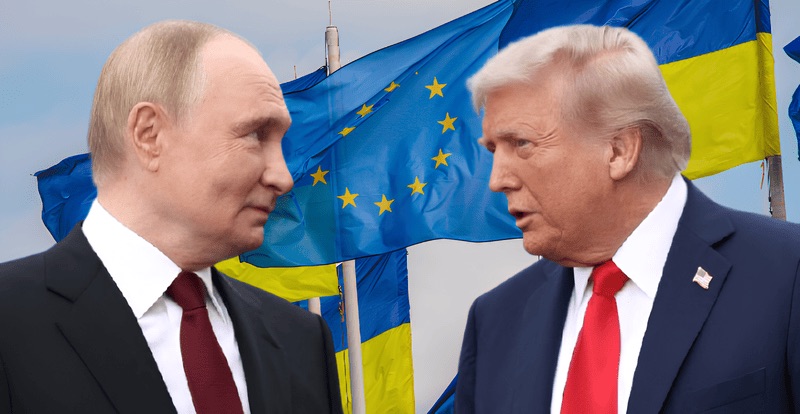
From February 24, 2022, the day Russia invaded Ukraine, until the end of 2025, 1,406 days of war will have passed, a fact that should trouble the consciences of those who still merely speak of a “protracted conflict”, as if it were an abstraction, rather than an ongoing human tragedy.

When, at the beginning of the year 2025, Donald Trump returned to power, many anticipated profound changes in the global security and defence landscape. Few, however, imagined that this transformation would be so disruptive and unprecedented.
As the year progressed, Europe gradually realised that the United States had become less reliable and less cooperative, whether by deliberate strategy or because Trump remains excessively focused on his own ego and on supposed “peace” achievements, more proclaimed than delivered.
In the disastrous meeting between Trump and President Zelensky at the White House on February 25, transatlantic relations hit a new low. However, it was also the decisive moment that made Europeans realize the need for a change in approach.
Since then, Zelensky and his European allies have learned how to deal with Trump. They give him the stage, allow him to proclaim victory, and only then explain, with strategic patience, why what he wants cannot be done. The famous “Yes, but…” method. Trump does not appear to be genuinely interested in ending the war, but rather in what he can extract politically from this saga and what enhances his image. And the reality is that, after almost a year of this exercise, we all understand the mechanism — and even knowing it does not work with Putin, we collectively continue to pretend that it does.
Putin has recently reiterated what no longer leaves room for doubt: the war will end only with Ukraine’s surrender, and none of the proposals currently under discussion are acceptable to the Kremlin.
In parallel, reality shows that the United States does not intend to offer Ukraine real effective security guarantees. Even the idea of a “softened Article 5” is being progressively hollowed out, walked back rhetorically and diluted in practice, confirming that for Washington the commitment remains more rhetorical than real.
The debate about the EU using frozen Russian assets to financially support Ukraine, sparked by the perception that the once-reliable ally is no longer so, has been one of the most confusing and tense moments in the 27-member European Union.
Finally, the European Council agreed to provide a loan to Ukraine for the years 2026-2027 based on EU borrowing on the capital markets. However, what mattered most, was assured: Ukraine will obtain the necessary financial help and will keep its cards on the table. Europe had no alternative: withdrawing at that point would have been not only a political mistake, but also a strategic defeat.
Perhaps the most significant development in 2025 has been that Europe+ (including the United Kingdom and the other partners of the “Coalition of the Willing”) became fully aware of its position vis-à-vis the United States. The message was received. And Americans already know the response, even if they do not state it publicly: Ukraine’s allies may at first glance seem like a group of politicians of different sizes playing in a park, as if they do not know what is going on — but this group should not be underestimated. When matters become serious, with the predictable exceptions of Hungary, its occasional Slovak ally and the indecisive Czech position, there is no turning back. Russia and the United States tried to minimize and ignore Europe, without success.
The EU achieved hard-won successes this year. In Germany, the defeat of the AfD opened the way for the arrival of an upright and charismatic chancellor, Merz. In France, Macron seems finally to have consolidated his firmness. Meloni, in Italy, has played a surprisingly solid role in supporting Ukraine and continues to do so, while Ursula von der Leyen appears at last to have found her place at the head of the European Commission. Spain and Portugal, on Europe’s western edge, are beginning to face geopolitical reality with greater clarity. Despite concerns raised by the election of a right-wing president in Poland, the impact proved less disruptive than expected. Fico in Slovakia remains largely impotent and with little influence in the EU, while Orbán in Budapest grows increasingly isolated, focused on surviving a possible opposition victory in April’s elections. In the Czech Republic, the return of Andrej Babiš to power after his ANO party’s electoral victory and the formation of a coalition with right-wing and eurosceptic forces signals an intention to reduce direct military and financial support to Kyiv. Even so, President Petr Pavel, a retired general and a pro-EU and pro-NATO figure, ensures the continuity of initiatives such as ammunition supply. And one of Europe’s greatest victories was also the success of pro-EU presidential candidates in Romania and Moldova.
The Baltic States, now all NATO members, have formed with the EU an unequivocal front against Russia. Sweden has stood out as a solid ally, quietly assuming a leadership role within the group. Denmark, supported by Norway and the United Kingdom, has led the way in financing and producing armaments for Ukraine, also taking on direct production when necessary. In Belgium, Prime Minister Bart De Wever, under internal pressure, even if remained cautious regarding controversial financial instruments, such as the use of frozen Russian assets, demanding legal guarantees and European solidarity,still firmly supports Ukraine, No less important, Finland’s President Alexander Stubb has been one of the most notable intellects to lead his country and has played a crucial role in balancing relations with Trump. Poland has remained an exemplary ally of Ukraine, ensuring the security and transit of billions of euros’ worth of weapons and equipment, complemented by direct assistance.
The EU+ built factories, increased production and exceeded all targets in the manufacture of small arms and 155 mm ammunition, supplying Ukraine while replenishing its own stocks. The EU+ works closely with Ukraine to intensify drone defence, while Kyiv is building much of its own arms base, from artillery to armoured vehicles. It is not enough, but it represents a colossal advance compared to 2022. Secret factories, with decentralised production and final point assembly, have proven extraordinarily effective. Ukraine produces aerial, maritime and land drones with range and precision far beyond what Russia ever expected.
Today, drones are eyes, ears, defence and attack. Kilometres of fibre-optic cable cover fields and trees, forming a true aerial cage. Moving in daylight is almost synonymous with death. Ukraine dominates this new reality, and Russian losses are enormous.
The Russian advance has stalled. Ukraine, for its part, suffers partial exhaustion and external political pressure, but it does not yield. It adapts, learns and continuously creates new technologies. Zelensky has aged twenty years in four, yet remains firm. He moves forward, because Ukraine must move forward.
Some may say that, in this balance of 2025, this is a repetitive and excessively pro-Ukraine view. Perhaps it is, and in that I openly adopt and follow the inspiration of The Analyst.
Above all, it is the view of someone who believes that, sooner or later, justice prevails. Peace will come. And when that happens, it will bring with it a new and demanding challenge: rebuilding Ukraine and learning Europe to rely more on itself than on external promises.
Author: Fernando Figueiredo – Retired Portuguese Army colonel and former NATO professional, who held various strategic leadership positions, currently serving as a defense consultant at Pulsar Development International. His work focuses primarily on defense requirements, offering expertise and a network of contacts that enable operational challenges to be overcome with effective, tailored solutions.
(The opinions expressed in this article belong only to the author and do not necessarily reflect the views of World Geostrategic Insights).