



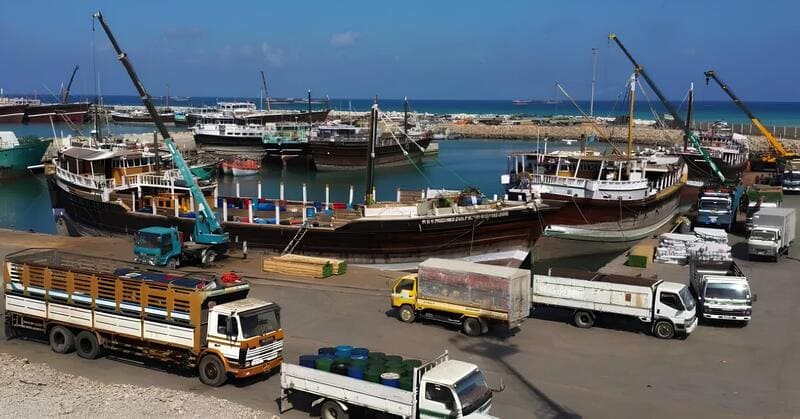
Bosaso’s strength lies in the steady current of trade that sustains its people and binds the city to global markets. The city’s economy runs on the predictable movement of livestock, fuel, and goods.

Over the past two years, that predictability has given way to a different flow: hazardous cargo arriving from the United Arab Emirates (UAE), staged at the port and transferred to the airport, and routed onward to the Rapid Support Forces (RSF) in Sudan through cargo plans. A force widely accused of atrocities in Darfur and mass violence in Khartoum and El Fasher.
Port managers and Puntland security officials report that these consignments skipped routine customs and safety procedures. Local officials were told to receive and forward the consignments, not to inspect or test them. The shipments included all classes of hazardous materials, from munitions and propellants to volatile fuels, corrosive and toxic chemicals, lithium battery systems, and other dual-use components, with failure modes that include detonation, fire, corrosive release, and persistent contamination of air and water. Moving such material through a dense city shifts blast risk and long-term contamination onto Bosaso’s residents while operational control sits outside Somalia’s authority.
Hazardous in this context is not an administrative label. In maritime and aviation practice, it refers to cargo that can explode, ignite, corrode, or poison, including munitions, propellants, volatile fuels, corrosive chemicals, and dual-use systems such as drone components and electronic warfare kits with dense lithium batteries. These are not being stored in isolated military facilities. They are being handled in a dense coastal city where homes, markets, and warehouses sit within meters of each other.
That choice transfers the full weight of danger to Bosaso in Puntland. The risks are threefold: a physical risk of explosion, an environmental risk as toxins linger in air, settle in soil, and travel with water, and a moral and reputational risk if the city becomes fixed in the public mind as a corridor for a condemned war.
On 26 October 2025, after months of siege, the RSF took over El Fasher. The city fell not only to arms but to impunity long in the making. In response, the ICC Prosecutor put parties on notice that the reported mass killings, systematic rape, and attacks on civilians may meet the Rome Statute’s gravest thresholds and began preserving evidence, a reminder that accountability moves up the chain of command and outward to those who enable the violence. The signal was clear: liability extends from field units to commanders and to those who finance, and those who facilitated the impunity can also incur responsibility. The implication is plain: any actor that sustains the RSFs alleged crimes against humanity now carries legal and political exposure, and Puntland’s authorities have a duty to break that chain.
The UAE dimension matters. Multiple investigations describe a logistics bridge linking UAE airfields to RSF corridors, with Bosaso used as a forward node, while Abu Dhabi denies arming the RSF. Open-source reporting has noted frequent cargo flights and a foreign-operated radar near Bosaso’s civilian runway, consistent with a militarized logistics pattern. Whether labeled defensive or logistical, such systems raise the likelihood that adversaries view Bosaso as a legitimate node and potential target.
The parallel to Beirut in 2020 is instructive. A civilian port was destroyed not by invasion but by hazardous stockpiles under weak authority. Bosaso is being placed in a similar position by design, asking citizens to live beside dangerous materials without transparency, oversight, or consent.
This risk is measurable. Explosives leave traceable residues. TNT and RDX bind to dust and quay surfaces. Oxidizers add perchlorates to runoff. Primers seed soil and sediment with lead, mercury, and antimony. Solvents enter drains. When lithium batteries burn, they do not burn clean. They leave fluorinated gases and fine dust that hang in the air, work into the lungs, and eat at metal. In Bosaso, the rain that should rinse the city instead carries this residue off roofs and loading yards into open drains that reach the Gulf of Aden. What should rinse the city carries poison to the sea.
This is chemistry and governance. A port without filtration, routine testing, or adequate firefighting capacity forces families and fishermen to carry risks they did not choose. Somalia has seen how weak oversight turns accidents into national wounds. The remedy is clear: test, disclose, repair, and protect the city that bears the cost.
Bosaso lacks a treatment plant. Stormwater drains directly to the ocean, carrying oil, solvents, and ash from small fires. UN urban and environmental assessments have warned about this pattern; its effects are visible in oily films near shore and rising respiratory and skin complaints in port-adjacent districts.
The danger is systemic: hazardous handling, weak oversight, and minimal environmental controls. Each spill or fire adds to a cumulative burden that threatens fisheries, export schedules, and public health. The remedy begins with evidence and disclosure: sample drains, shoreline, and seafood for fluorides, nitro-compounds, and heavy metals; publish results; and enforce source control and compliant storage before trade and health costs escalate.
Beyond the physical risk lies an institutional one. The available record suggests Puntland’s leadership ceded effective control over parts of the port and airport to a foreign partner without parliamentary review or federal consent. If verified, this breaches Somalia’s (and Puntland’s) law and narrows the corridor through which legitimate authority grows.
The economic penalty follows. Once a port is perceived as a transit point for illicit or military cargo, insurers and shippers reprice risk. Premiums rise, vessels avoid calls, and schedules slip. Exporters and trucking firms lose first; households follow.
This is the familiar trap for states with fragile institutions and limited resources. Trading oversight for speed may deliver equipment and training, but it also imports another actor’s war aims, environmental risk, and reputational damage. The IMDG Code and ICAO rules exist to prevent precisely these externalities, and UNEP’s guidance shows how quickly residues move from aprons to drains to the sea. Real authority is earned in the open, where accountability builds trust, and trust gives power its meaning. When institutions disregard scrutiny, they weaken the state’s ability to govern and to command the confidence of its own people.
An urgent UN-led investigation is now necessary. The mandate should be technical, public, and time-bound. It must establish what is entering Bosaso, how it is stored, and what residues it leaves. Without an independent baseline, speculation grows, trust erodes, and the city’s economic reputation suffers.
Begin with environmental forensics. Task UNEP, with WHO and accredited labs, to run a rapid sampling grid: quays and warehouse floors for contact residues, drains and groundwater for plume movement, and near-shore sediments for marine uptake. Test for TNT, RDX, perchlorates, primer metals, and fluorides from lithium fires. Verify with split samples, publish methods and full datasets, and map hotspots for public reference. Use the findings to order immediate containment and cleanup, strengthen port regulations in line with international codes, and show that Somalia’s institutions can protect both commerce and public health through evidence, not secrecy.
A parallel safety and compliance audit must follow. Inspect operations against international maritime and aviation codes for dangerous goods. Identify consignments that lacked proper manifests, the authorities that granted exemptions, and whether cargo violates UN arms embargoes or Bamako and Basel controls. This is how legal clarity and institutional credibility are restored.
Center the inquiry on human health. Screen exposed workers and nearby residents for respiratory and skin disease, with labs for explosive- and solvent-related biomarkers. Equip Bosaso clinics to code cases by job and location, publish monthly trends, and build a baseline for follow-up. Use these data to target cleanup, enforce safer storage, and protect surrounding neighborhoods.
The investigation must end with enforceable risk-reduction orders. Until safety is verified, suspend handling and storage of Class 1 explosives and volatile chemicals inside the civilian port and airport. Relocate any stockpiles to compliant facilities outside residential areas under Puntland’s jurisdiction and independent supervision. Identify responsible officials and firms, apply sanctions, and fund remediation.
Only a transparent, technical, time-bound inquiry can replace rumor with data and secrecy with accountability. Sovereignty is exercised not in speeches but in procedures, in independent inspection, full disclosure, and enforcement with consequences. It begins at the Bosaso port gate, where the lives of citizens meet the responsibilities of the state.
Author: Abdisaid Muse Aliis – Chairperson of the Lome Peace and Security Forum and former Minister of Foreign Affairs and International Cooperation of Somalia. He has over 15 years of experience working with international companies and governments in the Horn of Africa, including regional security sector strategy projects, proposal development, team management and leadership, and advisory responsibilities, at national, regional and global levels.
(The opinions expressed in this article are solely those of the author and do not necessarily reflect the views of World Geostrategic Insights).