



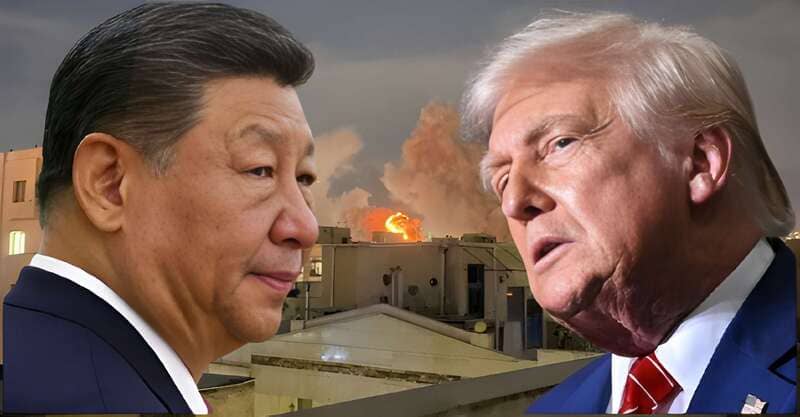
Iran is a fundamental strategic consideration for Israel. China is a fundamental strategic consideration for the United States.

Should America’s war against Iran weaken it vis-à-vis Beijing, this would be a strategic mistake for Washington. If the opposite is the case, and China is seriously affected as a result of this war, it would be a strategic win for the U.S. in relation to its main international contender.
China’s Vulnerabilities
Two obvious vulnerabilities emerge for China as a consequence of America’s actions in Iran. First energy. Second image. The closure of the Strait of Hormuz and the shutdown of Qatar’s liquified natural gas (LNG) exports, impact China in a direct way. Half of China’s oil imports and nearly one-third of its LNG imports transit through this waterway. (Downs, 2026).
On the other hand, China’s inability to protect a strategic ally as Iran, projects an image of weakness and unreliability towards its network of strategic partners in the Global South. This, of course, comes on top of Maduro’s seizing and Venezuela being transformed into an American Protectorate.
The aforementioned vulnerabilities, however, have their offset. First, China spent last year building up stockpiles of oil. In 2025, indeed, it increased its oil imports by 4.4%, with more than 80% of that increase being stockpiled. This, with the specific aim of protecting itself against potential supply shocks. For several months, as a result, China will be able to weather disruptions in the strait of Hormuz. (Hawkins, 2026).
On the image front, meanwhile, whatever the shortcomings derived from its inability to protect its strategic allies, are being compensated by becoming a serious and global counterbalance to America’s recklessness and adventurism.
America’s Vulnerabilities
Contrarywise, the United States’ actions in Iran are generating two major vulnerabilities for that country, in relation to China. Vulnerabilities that cannot be easily offset. Much to the contrary. Firstly, because it depletes in a secondary strategic theater its already dwindling stockpiles of offensive and defensive missiles. Secondly, because it increases China’s already overwhelming leverage, in relation to the critical minerals required for producing those missiles.
Draining limited weapons stockpiles in Iran, lowers its availability for a Taiwan or South China Sea contingencies. Especially so, because when it rains it pours. As Mike Fredenurg wrote last year: “Historic levels of air defense missiles were expended by U.S. Navy ships in the Middle East in defense of Israel and in protection of Red Sea shipping since October of 2023. This led Admiral James Kilby, Naval Operations acting chief, to testify in June that their ship-launched air defense interceptors are being expended at an ‘alarming rate’ in defense of Israel”. (Fredenurg, 2025).
Indeed, every Tomahawk offensive missile or every Patriot or Thaad defensive missile now being used against Iran, might be missing if needed against China. Specially so, as “each missile fired is costly and can take years to replace, potentially creating what some analyst see as a longer-term vulnerability for the US…‘Missiles are in short supply and the US is not building them fast enough to catch up, Clark [Bryan Clark, Hudson Institute fellow] said”. (Stancy, 2026).
On the other hand, China’s control over critical minerals has become a major strategic concern for the United States, as many of these materials are essential for modern military systems, including offensive and defensive missiles. Key critical minerals used in missile production include rare earths (used for guidance systems), germanium and gallium (used in semiconductors and radar electronics), graphite (used in missile batteries and electronics), tungsten and hafnium (used for high-temperature components), or nickel, cobalt and vanadium (used in superalloys for engines). China’s control in this area is simply overwhelming: 90% of rare earths processing, 98% of refined gallium production, and so on. (Duhalde, Lo and Choi, 2025; McNeal, 2025; Baskaran and Schwartz, 2022).
The U.S., thus, is rapidly depleting a decreasing weapons’ reservoir, whose replenishing is contingent on China’s willingness to supply the needed commodities. In doing so, the United States is putting itself in the hands of its main strategic rival. Common sense would advise to use such stockpiles wisely, and not waste them in knocking down Iranian drones that cost but a small fraction of a Patriot missile.
By attacking Iran, America has much more to lose than China. This war, indeed, not only represents a big and unnecessary distraction against the U.S.’ main strategic objective, but a major blunder insofar as it strengthens China’s “cards”. So good these cards are that they would provide Beijing with a window of opportunity for invading Taiwan, if it so decides.
References:
Baskaran, Gracelin and Schwartz, Meredith (2022). Critical Minerals and the Future of the U.S. Defense Industrial Base. Washington, DC: CSIS.
Downs, Erica (2026). “Implications of the Conflict in the Middle East for China’s Energy Security”, The Center on Global Policy at Columbia University, March 4.
Duhalde, Marcelo, Lo, Joe and Choi, Vincent (2025). “How US military power depends on China’s rare earths”, South China Morning Post, June 11.
Fredenurg, Mike (2025). “US missile depletion from Houthi, Israel conflicts may shock you”, Responsible Statecraft, Quincy Institute, August 7.
Hawkings, Amy (2026). “Trump’s show of force in the Middle East creates a weakness that China can exploit”, The Guardian, 3 March.
McNeal, Dewardric (2025). “U.S. is losing rare earth metal war to China, and running out of time to win it back”, CNBC, June 29.
Stancy, Diana (2026). “Iran mission takes toll on US munition stockpile”, Breaking Defense, March 3.
Author: Alfredo Toro Hardy, PhD – Retired Venezuelan career diplomat, scholar and author. Former Ambassador to the U.S., U.K., Spain, Brazil, Ireland, Chile and Singapore. Author or co-author of thirty-six books on international affairs. Former Fulbright Scholar and Visiting Professor at Princeton and Brasilia universities. He is currently an Honorary Fellow of the Geneva School of Diplomacy and International Relations and a member of the Review Panel of the Rockefeller Foundation Bellagio Center.
(The opinions expressed in this article belong only to the author and do not necessarily reflect the views of World Geostrategic Insights).