



There is something worth sitting with in the fact that the United States Trade Representative’s 2026 Trade Policy Agenda, released just days ago, lists managing trade with China for “reciprocity and balance” as one of its six central priorities.

That is a meaningful word choice from an administration that, barely twelve months ago, was imposing tariff rates of 145 percent on Chinese goods and watching bilateral trade volumes fall to levels the world had not seen since China first entered the WTO. The shift in framing does not mean hostility is over. It means that even Washington’s most China-sceptic policymakers have absorbed what the data from 2025 made unavoidably clear. Trying to win an economic war against your largest integrated trading partner produces losses faster than it produces leverage.
Economic relations between the United States and China occupy a central position in the global economic system. Their combined economic weight shapes trade flows, capital markets, and development pathways across the world. The two economies together account for close to forty percent of global output and hold decisive influence over manufacturing networks, financial systems, and technological innovation. The 2025 tariff escalation was, by any measure, an economic stress test that neither side passed. China’s global trade surplus grew to a record $1.19 trillion in 2025, not because Chinese exporters were thriving under American pressure but because they rerouted goods to markets that did not carry 145 percent entry taxes. American consumers, meanwhile, absorbed an estimated $1,500 per household in additional costs from tariffs that were legally justified under emergency powers the Supreme Court ultimately ruled unconstitutional in February 2026. The bilateral relationship recorded its largest single-year trade volume drop since formal diplomatic ties were established in 1979.
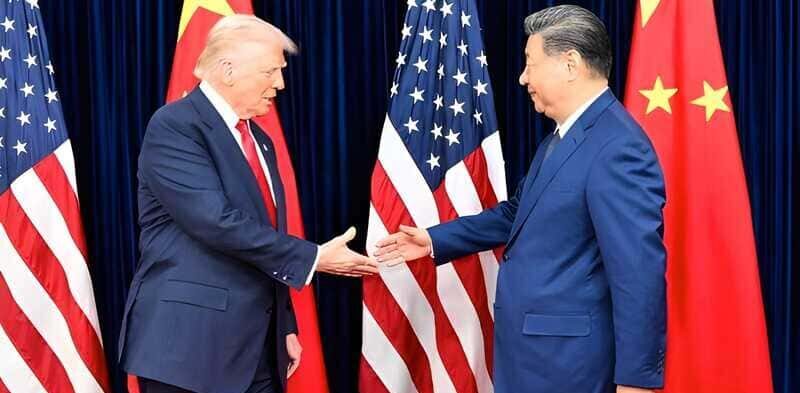
What makes the current moment analytically interesting is that the damage did not produce the political outcome that economic pain usually generates in bilateral disputes. China did not yield on its core industrial policy framework. The US did not see a domestic manufacturing rebound in ways that justified the consumer cost. Instead, both governments arrived at the Busan summit in October 2025 with enough bruises to agree to a structured pause, a one-year truce extension, China recommitting to purchasing American soybeans, and a suspension of rare earth export controls that Beijing had deployed as a pressure instrument. Neither side called it a victory. Neither could afford to.
The April 2026 Trump-Xi summit, now confirmed with trade chiefs set to meet in mid-March ahead of it, will be the first real test of whether the truce becomes something more durable. The historical pattern here is not encouraging. High-level meetings between the two governments have repeatedly produced announcements that dissolve within months once the political incentives on either side shift. But 2026 carries a structural difference from previous diplomatic cycles. The February Supreme Court ruling dismantled the legal architecture that made unilateral tariff escalation easy. A 10 percent global tariff under Section 122 is now the operative baseline, valid for 150 days and requiring congressional approval to extend. This is a slower, more constrained mechanism. It creates, somewhat accidentally, a window for economic engagement that does not depend entirely on presidential whim.
The business community has already started moving through that window. An AmCham China survey released in January 2026 found that 79 percent of member companies held a neutral or positive outlook for US-China relations in the coming year, a 30-percentage point improvement from 2025. Sub-national cooperation is quietly advancing in parallel, with delegations from Chinese provinces and American states meeting to discuss healthcare, green energy, and consumer markets. Medtronic, which entered China in 1989, now treats it as its second-largest global market. Walmart has operated there since 1996. These companies did not build that presence to abandon it, and they have been far more active than their governments in maintaining functional economic relationships through the turbulence.
The deeper argument for enhanced collaboration is structural. The US and China together account for roughly 43 percent of global GDP. When the relationship contracts sharply, the effects do not stay bilateral. Southeast Asian manufacturers who absorbed rerouted supply chains during the tariff war are now exposed to second-order shocks if US-China trade normalizes without warning. Global commodities markets adjusted to Chinese demand patterns that shifted during the escalation. The idea that two economies this large and this integrated can decouple cleanly, or that managed hostility is costless, has been empirically tested and found to be wrong.
The January 2025 launch of DeepSeek, the Chinese AI model that matched American frontier AI performance at a fraction of the cost, illustrated one more dimension that tariff logic cannot address. Export controls on semiconductor chips did not slow Chinese AI development. They accelerated domestic investment in it. The Chinese chip output more than doubled between 2018 and 2023, years of consistent US export pressure. When coercive economic tools produce the opposite of their intended effect, the rational response is to ask what a cooperative alternative might achieve instead.
The honest version of the US-China economic argument in 2026 is not that the two countries should ignore their conflicts. It is that the architecture for managing those conflicts has been improvised, episodic, and expensive. What a structured, rules-based bilateral economic framework would offer is not friendship but predictability, and predictability is worth more to global markets, to business investment cycles, and to long-term strategic planning than any short-term political signal that either tariffs or summits can generate. The mid-March trade talks will show whether both governments understand that.
Author: Muhammad Asif Noor – Founder Friends of BRI Forum, Advisor to Pakistan Research Center, Hebei Normal University.
(The views expressed in this article belong only to the author and do not necessarily reflect the views of World Geostrategic Insights).
Image Source: Xinhua (President Xi Jinping with U.S. President Donald Trump in Busan, the Republic of Korea, October 30, 2025).