



By Yasir Masood
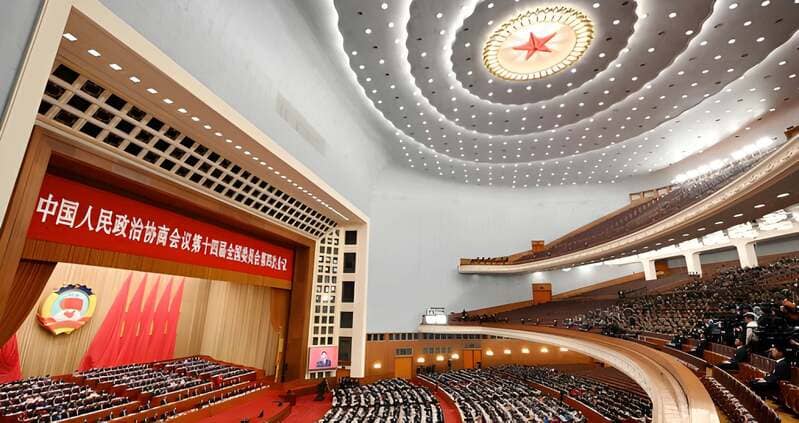
The ongoing “Two Sessions” are the largest political events of a calendar year in China, which encompass both the highest political advisory body, the Chinese People’s Political Consultative Conference (CPPCC) and the legislative organ, the National People’s Congress (NPC). These meetings serve as a rigorous review of China’s national economic, political and social progress and set future development goals.

But this year’s sessions take place against a backdrop of a plethora of external challenges to China, like the trade war, economic decoupling, geopolitical fragmentation and global governance issues. In response, policymakers are prioritising internal stability, resilience and upward trajectory of development to absorb these external shocks effectively.
At the fourth session of the 14th National People’s Congress, Premier Li Qiang presented the Government Work Report (GWR) on 5 March 2026, which outlined economic development objectives by 2026, including a target of a 4.5-5% GDP growth rate to ensure a stable course of development. However, in the previous year, the GDP reached above 140 trillion yuan while the growth rate was around 5%.
Interestingly, 2026 is also the inaugural year of the 15th Five-Year Plan (FYP) of the country for 2026-2030. In China’s development journey, usually the FYP and the GWR together complement short-term economic goals with a longer strategic plan anchored in self-reliance, resilience, continued progress, opening-up and incremental reforms to serve the common people at the heart of its strategy.
Innovation and technological modernisation form the first major pillar of the 15th FYP. What stands out analytically about the 15th FYP is China’s push towards a modernisation outlook by 2035, particularly around innovation, artificial intelligence, green transition, Research and Development (R&D) and investing in education through high-quality, inclusive development. In this context, the draft outline proposes 109 major projects across six fields to operationalise these strategic priorities, from steering the development of new quality productive forces to ensuring public well-being. These projects are meant to speed the conversion of research budgets into tangible products, factories and systems that can be exported. The idea is that R&D spending should translate into companies that can scale and products that can compete globally, which explains the growing use of performance-based financing, pilot zones and procurement preferences.
China’s total expenditure on R&D in 2025 amounted to around 3.9 trillion yuan, accounting for about 2.8% of the country’s GDP, up from 2.69% in 2024. Notably, the major share of these funds comes from enterprises. At the sectoral level, the areas of major breakthroughs identified in the GWR and the FYP outline include next-generation information technology, artificial intelligence, quantum technologies, brain-computer interfaces, biomanufacturing, fusion, hydrogen and high-end equipment. China pairs public investment with targeted industrial policy and national pilot projects to build shared platforms, data resources and regulatory frameworks that help technologies such as AI spread rapidly across factories, ports, power grids and hospitals, which the Stimson Centre has described as “treating AI as infrastructure.” Undoubtedly, that could accelerate diffusion significantly, but it also raises questions about standards, data sharing and governance for anyone connected to those systems.
Green transformation is the second major pillar. The 15th FYP has a higher correlation of qualitative growth with a shift to a low-carbon economy. China upgraded clean energy production in 2025 and cut carbon intensity. The plan ties industrial upgrading to emissions and efficiency targets and funnels support into new energy, hydrogen and nuclear, alongside a fast expansion of electric transport. The objective is to move China from scale to sophistication, not only as the world’s biggest builder of renewable energy technology but as an exporter of integrated decarbonisation solutions.
Apart from technology and the green agenda, the third major element of the plan is the strengthening of macroeconomic and social resilience in order to sustain economic stability in the country. This includes creating 12 million new jobs in urban areas in 2026, maintaining the urban employment rate while targeting consumer inflation at around 2%. The deficit as a percentage of GDP is around 4% this year, indicating a shift towards easing transition costs rather than providing a strong stimulus. Policymakers also want to stabilise household incomes, services and small-scale enterprises, pointing to an effort to strengthen China’s domestic consumption base.
A critical mechanism for this resilience is the building of a more unified national market. The emphasis on domestic circulation places greater weight on expanding internal demand while keeping openness to global markets. It involves taking the matter of clearing internal obstacles seriously, streamlining logistics coordination and aligning provincial regulations to ensure the entire system operates more effectively. A larger, more integrated domestic market will perform a dual role: stabilising domestic growth and ensuring that China continues to be a reliable source of import demand by trading partners.
This internal strengthening also shapes China’s external economic engagement. The Belt and Road Initiative today is less about big infrastructure and roads. The focus now runs towards sectoral cooperation, green energy, digital infrastructure and industrial ecosystems. It also brings overseas partnerships into step with China’s domestic push for technological and industrial upgrading, opening practical routes for Chinese companies to sell digital and green infrastructure solutions abroad. This will help Asian, African and Latin American markets, as Chinese green infrastructure projects will form a share of climate investments in those regions.
Job creation, support for smaller firms and regulatory coherence will determine whether this structural shift holds up socially. The risks are real as well. Export controls and technology denial could cut both ways. Some regions may struggle to absorb concentrated industrial investment. A prolonged property downturn could weigh on household spending. And rolling out AI at that scale will also test governance systems across the board.
In my view, the next five years will be defined by three closely interconnected factors. First, core technology catch-up. If China succeeds in centralising the benefits of R&D into globally competitive companies in semiconductors, AI platforms and advanced manufacturing, the 15th FYP could bring structural improvements to productivity. Second is the pressure of containment and de-risking. Export restrictions and geopolitical tension are compelling China to re-invest in self-reliance at major technological nodes and diversify supply chains and market relationships. Third, social stabilisation. The adjustment of the property sector and the ability to generate new jobs for an ageing society will determine whether improving quality growth remains politically and economically stable.
Over the next couple of years, several indicators will be worth watching: how much R&D becomes licensed technology and how much turns into new startups; export revenues from integrated green and digital systems; net job gains in advanced sectors and services; and improvements in interprovincial logistics efficiency. Are rules actually being harmonised across provinces? Those metrics will reveal far more about the plan’s effectiveness than any GDP headline alone.
The 15th FYP provides continuity, with faster and smarter growth. In Beijing, the centre of attention is evident: to invest in R&D, support a few industrial priorities and step up green and digital solutions. It aims to have a more innovative and cleaner economy that is driven by domestic demand by the year 2035. For partners and beyond, cooperation with China in green and digital areas should continue, as collaboration can yield genuine dividends.
Author: Dr. Yasir Masood – Pakistani political and strategic analyst, academic, and broadcast journalist specializing in strategic communication. He holds a PhD in International Relations with a focus on the Balochistan conflict. His work spans South Asian geopolitics, Pakistan’s foreign policy, U.S.-Pakistan relations, China’s Foreign Policy, and the China–Pakistan Economic Corridor (CPEC). He regularly provides commentary to leading global media outlets and think tanks.
(The views expressed in this article belong only to the author and do not necessarily reflect the views of World Geostrategic Insights).
Image Source: Xinhua