



Timelines
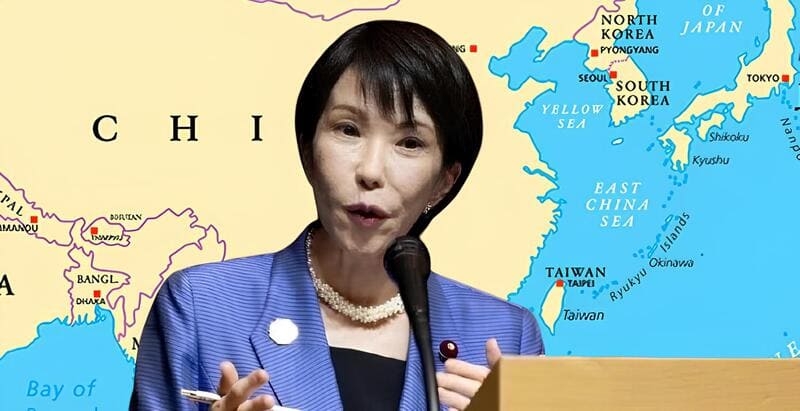
At a Diet meeting on November 7, Japan’s first female Prime Minister Sanae Takaichi remarked that a Taiwan crisis involving military operations from the Chinese mainland could constitute a “survival-threatening situation” for Japan. According to its legislation, Japan’s Self-Defence Forces could exercise the right of collective self-defence as a result.
These provocative remarks from Japan’s new leader drew immediate ire from Beijing. China’s Foreign Ministry decried the “blatant interference in China’s internal affairs, serious violation of the one-China principle, breach of international relations norms, and undermining of the four political documents between China and Japan”.
The four important documents are the Sino-Japanese Joint Declaration (1972), acknowledging the “One China” policy; the Treaty of Peace and Friendship (1978), promoting mutual respect, cooperation, peaceful coexistence and non-aggression; the Joint Communiqué on the Establishment of Diplomatic Relations (1972), highlighting economic and cultural exchanges; and the China-Japan Joint Statement on Cooperation in the 21st Century (2008), reinforcing cooperation in trade, investment, and environmental protection, addressing historical grievances and enhancing mutual trust.
In response to Beijing’s blowback, Takaichi insisted that her remarks were in line with the government’s longstanding view and she had no intention to retract the remarks.
A Chinese Defence Ministry spokesperson warned that if Japan uses force to interfere in the Taiwan question, it would “suffer a crushing defeat”.
As a warning, a China Coast Guard fleet patrolled the territorial waters of the disputed Diaoyu/Senkaku Islands. Further punitive measures followed, including a travel advisory warning for Chinese nationals intending to visit Japan, suspension of all Japan’s seafood imports; halting Japanese business and cultural activities on the Chinese Mainland; postponing a China-Japan-S. Korea Ministerial Meeting scheduled for 24 November; and confirming no plans for Chinese Premier Li Qiang to meet his Japanese counterpart during the G20 meeting in South Africa from 22-23 November.
Where Takaichi comes from
With a male-dominated Japanese culture, Takaichi’s rise to becoming the first female Prime Minister of Japan is no mean feat. She and her mentor former Prime Minister Shinzo Abe were vanguards of Japan’s postwar revisionism, touting amendment of the defeated nation’s constitution in order to re-arm Japan “as a normal country”, including power projection to regain Japan’s regional and global influence.
Both Takaichi and Abe have also been known as anti-China hawks. They represent powerful right-wing elements in Japan’s body politics. which (unlike the famous public silent attrition of former West German Chancellor Willy Brandt for Nazi crimes) sees no need for Japan to apologise for its actions in the Second World War, denying atrocities in the “Rape of Nanjing” where 200,000 -300,000 Chinese nationals were butchered. As politicians, they continued to pay annual homage to the Nakasone Shrine honouring “Japanese martyrs” including those classified by postwar international tribunals as Class A War Criminals.
Takaichi may also be bolstered by the United States’ enduring China containment strategies. Coming to mind are American military assets in the “First Island Chain” centred in Okinawa, the Second Island Chain” centred in Guam, the US-brokered Quadrilateral Security Dialogue (QUAD), an US-Japan-Australia-India military alliance, and the Australia-UK-US (AUKUS) nuclear-powered nuclear submarine deal. China is the prime target in all but name.
Against this American anti-China backdrop, by her remarks on Taiwan, Takaichi probably thinks that she could place Japan more in President Trump’s good graces, apart from reaping political capital from her anti-China constituents.
Takaichi also seems to think that she can continue to reap trade and other economic benefits from simultaneously engaging with China, perhaps trying to emulate President Trump’s ability of eating one’s cake and having it at the same time.
Taiwan history
The island of Taiwan had been part of China from historic times, dating back to the Ming Dynasty (A.D. 1368 to 1644).
Japan seized Taiwan (and the Penghu Islands) from the defeated Qing dynasty of China in 1895 through the Treaty of Shimonoseki in the First Sino-Japanese War, administering Taiwan as a formal colony of Japan. During World War II, Taiwan served as a critical military staging point and source of resources for Japan’s invasion of Southern China and Southeast Asia.
Japanese rule ended in September 1945 upon its surrender to the Allied powers. The Republic of China (ROC), led by Kuomintang Leader Chiang Kai-shek, was designated by the Allies to accept the surrender and take control of the Island on October 25, 1945.
Following China’s civil war, the hugely corrupt and unpopular Kuomintang government was defeated and retreated to Taiwan while Chairman Mao established the People’s Republic of China (PRC) on the Mainland.
During the US-Soviet Union Cold War, President Richard Nixon saw fit to reach a rapprochement with Chairman Mao to bring Mainland China on the side of the United States, in exchange for precipitating formal recognition of the PRC (in lieu of the ROC) by the United Nations as representing China and creating America’s “One China Policy”.
In 1979, President Jimmy Carter introduced the Taiwan Relations Act to ensure commercial and cultural relations with Taiwan, mandating the supply of defensive armament to Taiwan and opposing any non-peaceful means to determine the Island’s political future.
US current policies on Taiwan
Unfortunately for Takaichi, her incendiary remarks do not seem appealing to President Trump. At a Fox News interview on those remarks, Trump appeared to defend Beijing by saying that “A lot of our allies are not friends either. Our allies took advantage of our trade more than China did.”
It’s obvious from President Trump’s current global peace initiatives that he doesn’t want a hot war with China, war-without-smoke with China on trade, technology, diplomacy, regional and global rivalry notwithstanding. Last of all, with the US-Japan Security Treaty, Trump is unlikely to enthuse about shenanigans trying to tie the United States to a Japanese anti-China war-chariot.
America’s policies on Taiwan remain rather consistent. America’s one-China policy is guided by the Taiwan Relations Act, “three joint communiques” and “six assurances”.
The Taiwan Relations Act authorises arming Taiwan to defend against any non-peaceful solution of the Taiwan question. The Three Communiques confirm the normalisation of relations with Beijing under the one-China policy. President Reagan’s Six Assurances for Taiwan explain that the United States had not taken any position on Beijing’s sovereignty over Taiwan, would not play a mediation role and would not end arms sales to Taiwan any time soon.
America’s policy is designed to preserve Taiwan’s democratic success story and the credibility of America’s security commitments without triggering conflict, while providing the time and space for an eventual peaceful solution acceptable to Taiwan’s people. Accordingly, Taiwan is to be accorded all the elbow room it needs as a flourishing democracy, where independent nationhood is not a prerequisite.
Moreover, Taiwan has become a globally important strategic asset by way of its dominance in high-end semiconductor chips – the new “oil” of the Fourth Industrial Revolution redefining commerce, human interaction and geopolitics.
However, if Beijing were to take over the Island, its navy and other military forces would have free rein in the Western Pacific, eclipsing US influence and power in that important theatre, with all that it implies.
It’s no wonder the US is trying to turn the Island into a “military porcupine” while carrying on with “freedom of navigation operations” (FONOP) naval patrols to challenge China’s territorial claims in the South China Sea.
Amid US-China rivalry, the Taiwan card is likely to be played over and again, with the US seeming to see the island as an “unsinkable aircraft carrier”.
Beijing’s Taiwan unification strategy
Taiwan unification is central to China’s “Second Centenary Goal” of national rejuvenation, purging the country’s psyche of a “century of humiliation” under the thumb of foreign partition. President Xi Jinping has reaffirmed on many occasions that Taiwan’s eventual unification, by peaceful means if possible, is to be realized by 2049 at the latest, the hundredth anniversary of the founding of the People’s Republic of China.
In Beijing’s eyes, America’s often ambivalent stance towards Taiwan’s status, highlighted by former Congressional Leader Nancy Pelosi’s provocative visit to Taiwan, only serves to fan separatist sentiments on the Island, gradually hollowing out the One-China policy.
Beijing enacted its Anti-Secession Law in 2005. A comprehensive panoply of land, naval and air military assets has since been developed and deployed to forestall Taiwan’s de jure independence, including “aircraft-carrier-killer” hypersonic missiles, and other assets with Anti-Access/Area Denial (A2/AD) capabilities to deter the approach of hostile forces.
China has the world’s largest naval fleet, with three aircraft carriers (and a fourth, probably nuclear, under construction) and fortified islands in the South China Sea.
Still, should push comes to shove, any full-scale amphibious military operation would be an extremely hazardous enterprise, risking a regional, if not world, war. In particular, the 130km-wide Taiwan Strait is almost four times the width of the English Channel. Moreover, the Island has very few sites suitable for coastal amphibious landings.
Nor would a full blockade of Taiwan be a less perilous operation, considering America’s regional network of military alliances, such as the QUAD, AUKUS, the Japan-South Korea defence partnership, and possible involvement of NATO members such as UK, France and Germany, let alone sanctions and other coercive tools.
Beijing has published three White Papers on Taiwan, the last in August 2022, all stressing preference for peaceful unification, with military option as the very last resort.
Meanwhile, cross-strait exchanges have vastly expanded. Despite reduced numbers, as many as 300,000 Taiwanese live and work on their businesses on mainland China. Bilateral tourism continues to flourish. More Taiwanese film directors, actors and actresses are making their cut on the mainland, as are Taiwanese start-ups, including up-market restaurants.
Beijing’s strategy for peaceful unification is being driven by a three-pronged strategy: military deterrence, economic and diplomatic pressure (all but a small handful of very small countries still recognise Taiwan as a separate country), and people-to-people exchanges.
The momentum is picking up towards the prospects of a negotiated deal on Taiwan’s unification, likely with even more favourable terms than for Hong Kong and Macao.
While most Taiwanese people remain opposed to unification, most also refuse to support formal independence. Most prefer to maintain the status quo indefinitely. However, when push comes to shove, a recent survey shows a majority of Taiwanese don’t want to risk their lives defending Taiwan militarily.
So, the dice is cast for a momentum towards negotiated peaceful unification, a targeted outcome from Beijing’s perspective, reminiscent of Sun Tzu’s Art of War – “winning without fighting”.
The perceived, oft-cited Beijing intention to invade Taiwan in 2027 is a misconceived red-herring. President Xi did mention 2027, the time needed for Beijing to build up unbeatable all-theatre military deterrence against any move for Taiwan’s de jure independence. But the year is intended as a contingency measure, not a target date for military action.
This popular mistaken belief has sparked off various counter-productive, and often costly responses in many countries. This misconception may also have contributed to Takaichi’s unproductive remarks on Taiwan.
With domestic backlash and regional unease building up against her dangerous remarks, Takaichi has since been known to have told her confidant aides privately that she probably overshot herself verbally. She recently dispatched one of her middle-level chiefs to visit Beijing trying to diffuse the resulting tension. Unfortunately, this has only served to deepen the rift, as this low-level attempt is, quite rightly, viewed as an affront to the issue’s gravity in Beijing’s eyes.
Looking forward, it may take some time to put China-Japan relations on a more productive track, in the light of strong recalcitrant right-wing political forces in Japan’s current body politics.
Nevertheless, Japan’s domestic challenges of worsening demographics, declining productivity, increased dependence on China’s tourism, trade and supply chain flows including components and critical rare earth elements, regional opposition to rocking the strategic boat, and last but not least, President Trump’s unlikely willingness to allow warmongering to alter America’s Taiwan policies, may all present an effective ballast in preventing the untoward China-Japan tension from getting out of hand.
Author: Andrew KP Leung, SBS, FRSA – International and Independent China Strategist. Chairman and CEO at Andrew Leung International Consultants and Investments Limited. He previously served as director general of social welfare and Hong Kong’s official representative for the United Kingdom, Eastern Europe, Russia, Norway, and Switzerland. He has been an Elected Member of the Royal Society for Asian Affairs and of the Governing Council of the King’s College London (2004-10); a Think-tank Research Fellow at Zhuhai Campus (2017-20); an Advisory Board member at the European Centre for e-Commerce and Internet Law, Vienna, and a Visiting professor at the London Metropolitan University Business School.
(The views expressed in this article belong only to the author and do not necessarily reflect the views of World Geostrategic Insights).