



By Marriyam Siddique
Regional conflicts often act as a ‘decisive catalyst’ compelling states to reorganise its internal architecture. The four-day crisis of May 2025 involving India and Pakistan have revolutionised the strategic outlook and outreach of Pakistan.

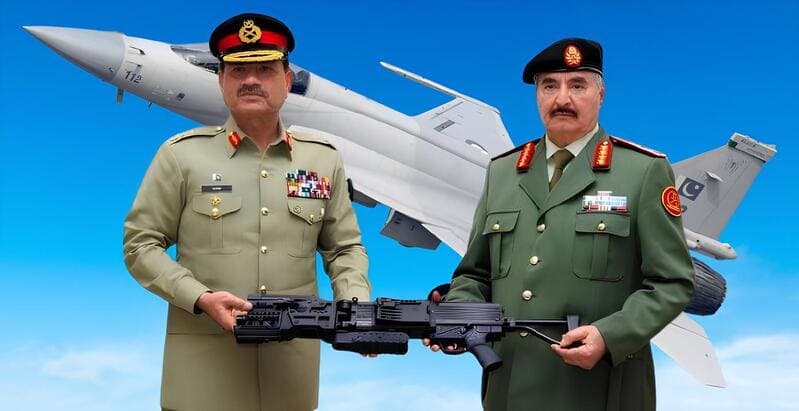
For decades, Pakistan has been viewed by the international community through the narrow lens of a ‘basket case economy’, a state perpetually standing on the doorsteps of the International Monetary Fund (IMF) and trading strategic concessions for its next billion-dollar tranche. Recent finalisation of a landmark $4 billion defence deal of Pakistan with Libyan National Army (LNA) symbolises a seismic stance in Islamabad’s ‘means of survival’ and ‘viability strategy.’
This historic deal is the opening salvo of a new era of ‘military diplomacy’ and not merely a commercial transaction, where Pakistan’s security establishment is moving beyond traditional defence to become the primary proponent of the state’s economic and industrial defence recovery. The deal is an attempt to reword Pakistan’s economic narrative by positioning itself as a high-tech arms exporter in the Global South, while concurrently consolidating a new, centralised power-systemic-structure under the command of Chief of Defence Forces (CDF).
The magnitude of the Pakistan-Libya deal, the most substantial in Pakistan’s history, necessitates a thorough reassessment of the state’s industrial competencies. Historically, Pakistan’s defence production has been perceived as largely reliant on Chinese or Western technology. However, Chief of Defence Forces Field Marshal Asim Munir contends that 90% of the defence equipment currently employed by Pakistan’s armed forces is produced domestically. The shift from merely consuming high-end hardware to offering proven solutions, including JF-17 Block III fighter jets, advanced drone swarms, and precision munitions. Through this agreement, Pakistan is using its Military Industrial Complex to boost the economy and earn foreign money, especially since typical export areas like textile and agriculture are no longer growing or making the same profits they once did.
Though, the geopolitical optics of this deal make it a complex matter. Pakistan has stepped into the volatile arena of North African power struggles by engaging with General Saddam Khalifa Haftar’s Libyan Arab Armed Forces (LAAF). Historically, Pakistan has pursued a stance to adhere to a policy of non-interference with UN-recognised governments. With this deal, Pakistan has adopted a pragmatic foreign policy by choosing to sell arms to those who control the oil-rich eastern half of Libya, often in opposition to the Tripoli-based administration. This pragmatic stance has prioritised the ‘Pakistan First’ approach that highlights immediate liquidity and strategic footprints over traditional diplomatic norms. In the age of ‘complex and messy multi-polarity,’ it reflects a strategic calculation that Pakistan can leverage its defence hardware to build partners with emerging power centres.
Pakistan’s state structure evolution has disembarked at a critical crossroads, marked by the centralisation of the CDF’s influential and decisive role. It operates with a holistic approach for overarching strategy, integrating defence with essential economic foundations, such as industrial schedules and sovereign credit frameworks. The strategic realignment was hastened by the Indian attempt to disrupt the regional balance through the May 2025 crisis, which required a cohesive and determined national stance. Through the amalgamation of security and commerce, Pakistan fosters a degree of institutional stability that attracts global partners in pursuit of dependable and lasting collaborations. Recent visits to Libya exemplify a transition towards a comprehensive approach to military diplomacy, emphasising the significance of stability and effective outcomes. This comprehensive strategy enables Pakistan to showcase a unified stance, promoting its structural robustness and operational reliability as a key asset in a progressively intricate global defence and economic environment.
The attainment of 90% indigenisation in defence production signifies a noteworthy advancement in Pakistan’s national stance, indicating a transition towards sophisticated industrial self-sufficiency. In its shift towards becoming a ‘Middle Power’ arms exporter, Pakistan is adopting a ‘Third Way’ for national survival emphasizing the export of sovereign technology rather than depending on conventional foreign aid or labour remittances. This model aims to stabilise the economy through the cultivation of advanced industrial pipelines that enhance the diversity of the nation’s export profile and establish enduring systemic resilience.
The $4 billion defence agreement with Libya acts as a fundamental driver for this economic stabilisation. The agreement presents a significant influx of foreign currency into the national treasury, granting a fiscal relief that underpins enhanced financial stability. In addition to its immediate financial benefits, the agreement cultivates a complex industrial ecosystem, creating high-skilled job opportunities and advancing technological innovation within the domestic manufacturing landscape. It is essential to note that Islamabad asserts this agreement is executed in complete accordance with United Nations standards and international legal structures, highlighting its dedication to legitimate sovereign collaboration and the prudent oversight of global supply chains.
Strategically, this shift establishes a significant regional imprint for Pakistan in the Mediterranean and North Africa. By marketing its ‘stability’ and institutional continuity as value-added components of its exports, Pakistan is positioning itself as an emerging ‘Arsenal of the Global South.’ This growing footprint has notable implications for Indian foreign policy. As Pakistan expands its diplomatic and technological influence into regions traditionally viewed as part of India’s ‘Extended Neighborhood,’ New Delhi must recalibrate its own regional engagement. The presence of Pakistani defence diplomacy in North Africa introduces new variables into the maritime and continental balance of power, challenging traditional South Asian influence patterns.
The ‘Garrison Pivot’ represents a calculated effort to monetize national defence prowess into a sustainable economic engine. The Libya deal acts as a proof of concept, demonstrating that institutional reliability and the guarantee of delivery are attractive commodities in a fragmented global market. If integrated effectively with civilian industrial goals, these defence-led successes could serve as the bedrock for a self-sustaining economy, ensuring that the dividends of technological innovation contribute to both national prosperity and a broader regional presence.
Author: Dr. Marriyam Siddique – Senior Research Fellow, Maritime Centre of Excellence, Pakistan Navy War College Lahore.
(The opinions expressed in this article belong solely to the author, do not represent the arguments of any institution, and do not necessarily reflect the opinions of World Geostrategic Insights).