



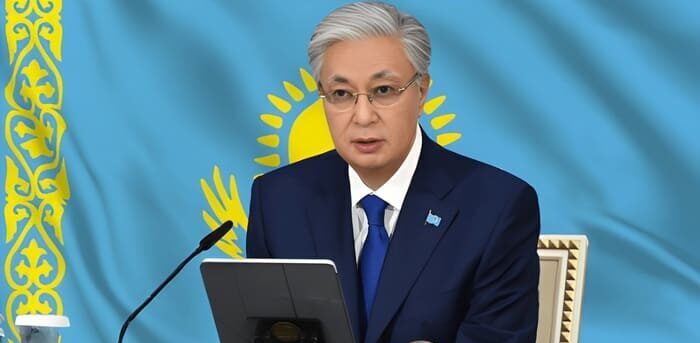
On March 15, Kazakhstan will hold a national referendum on a proposed new constitution designed to update the country’s governing framework nearly three decades after the adoption of its current constitution in 1995.

For Kazakhstan, the largest economy and geographically central state of Central Asia, the outcome of this process carries broader relevance for the stability and predictability of the Eurasian region.
Eurasia today is experiencing a period of significant structural change. Trade corridors, supply chains, energy routes and geopolitical alignments are all evolving in response to shifting global dynamics. Central Asia, once perceived as peripheral to global economic networks, is increasingly emerging as a strategic connector between Europe and Asia. Initiatives such as the Trans-Caspian International Transport Route, often referred to as the Middle Corridor, are reshaping the region’s role in international trade. In parallel, Western countries have intensified engagement with Central Asian states through diplomatic initiatives, economic partnerships and infrastructure cooperation.
Within this context, the internal stability of Kazakhstan carries particular weight. The country accounts for roughly two-thirds of Central Asia’s economy and occupies a geographic position that links Russia, China, the Caspian region and the broader Eurasian landmass. Stability in Kazakhstan therefore contributes not only to domestic development but also to the wider functioning of regional connectivity and cooperation frameworks.
Political stability, however, is not simply a matter of leadership continuity. Over time, it increasingly depends on the strength and clarity of institutions. Stable constitutional frameworks establish predictable rules governing the interaction of political actors, the transfer of authority and the functioning of state institutions. In regions characterized by complex geopolitical environments, institutional predictability can play a stabilizing role by reducing uncertainty and helping political systems absorb change without disruption.
The proposed constitutional reforms in Kazakhstan are largely aimed at modernizing institutional arrangements. The draft constitution clarifies Kazakhstan’s system as a presidential republic while introducing procedures designed to structure the relationship between the executive, legislative and oversight institutions. Several key state bodies, including the Constitutional Court, the Central Election Commission and the Supreme Audit Chamber, would be appointed by the president with the consent of the national parliament, known as the Kurultai.
These adjustments reflect a broader effort to embed political decision-making more firmly within formal institutional procedures. In many political systems, the long-term stability of governance depends less on the strength of individual actors than on the durability of the rules that guide their interactions. By clarifying appointment processes and institutional responsibilities, constitutional reforms can reduce ambiguity and help ensure that political competition unfolds within predictable frameworks.
Another notable feature of the proposed constitution is the explicit reinforcement of several core principles of statehood, including sovereignty, territorial integrity and the unitarity of the state. These principles are positioned at the foundation of the constitutional order and are defined as unchangeable elements of the political system. Their inclusion reflects an effort to anchor the political system around clearly defined constitutional fundamentals.
In a region as geopolitically complex as Eurasia, constitutional clarity around the foundations of statehood can play an important stabilizing role. Central Asia sits at the intersection of major powers and competing economic and security interests. Under such conditions, the durability of political institutions and the cohesion of the state itself become key elements of regional stability. Constitutional frameworks that clearly define the permanence of sovereignty and territorial integrity can help reduce the risk of political fragmentation or institutional ambiguity during periods of geopolitical change.
For Eurasia as a whole, such institutional consolidation matters. The region’s growing role in global connectivity, from energy exports to transcontinental transport corridors, means that stability within key states increasingly affects wider regional dynamics. Countries that function as economic and logistical hubs require political systems capable of managing both internal diversity and external geopolitical pressures. By codifying core principles of sovereignty and statehood, Kazakhstan’s constitutional reform can be seen as part of a broader effort to ensure that its political system remains resilient in an evolving regional environment.
Kazakhstan’s constitutional reform takes place at a moment when Central Asia’s international profile is rising. Kazakhstan in particular has positioned itself as a hub for trade, logistics and energy cooperation across Eurasia. The development of transcontinental infrastructure corridors, energy exports and critical mineral supply chains all depend on a stable and predictable policy environment.
In this sense, governance reforms can be viewed not only as domestic political developments but also as part of the broader evolution of Eurasia’s economic architecture. Countries that serve as transit hubs or regional economic anchors benefit from institutional frameworks capable of managing complex interactions between domestic policy and international engagement.
For Eurasia, a region undergoing rapid transformation, such institutional evolution matters. As new economic corridors take shape and international engagement with Central Asia deepens, the stability and predictability of the region’s political systems will increasingly influence the trajectory of cooperation across the continent.
Kazakhstan’s upcoming referendum therefore represents more than a domestic constitutional update. It is part of an ongoing effort to align the country’s governing framework with the demands of a changing Eurasian landscape – one in which institutional resilience and political predictability will play an increasingly important role in shaping regional stability.
Author: Prof. Michael Rossi – Lecturer in Political Science at Rutgers University of New Jersey, United States, and a Visiting Professor at Webster University Tashkent.
(The opinions expressed in this article are solely those of the author and do not necessarily reflect the views of World Geostrategic Insights).