



By Alberto Cossu
A Remote Island at the Center of Indo-Pacific Competition
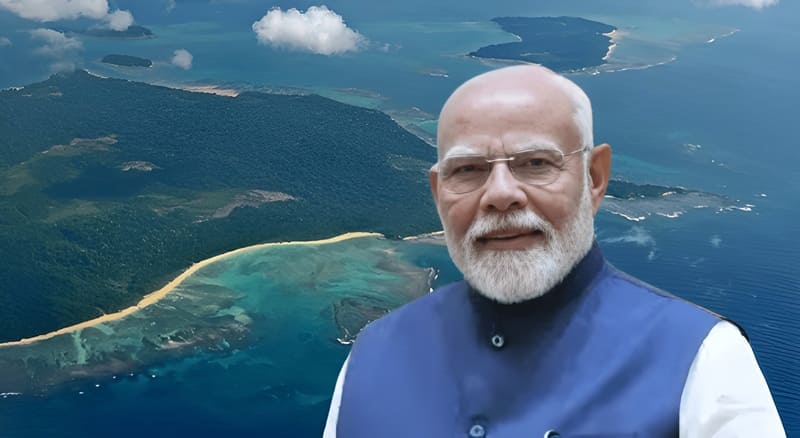
In February 2026, the National Green Tribunal (NGT) approved the Great Nicobar Island Project (GNIP), a massive infrastructure plan valued at approximately $9.7 billion, aimed at transforming one of India’s most remote islands into a major logistical, commercial, and military hub in the Indian Ocean.

The project envisages the construction of an international container transshipment port, a dual-use international airport serving both civilian and military purposes, a 400 MW green power plant, and a new port city designed to accommodate approximately 125,000 inhabitants, covering a total area of 166 km².
Behind this ambitious infrastructure initiative, however, lies a much broader strategic reality: Great Nicobar has emerged as a pivotal element in the strategic competition between India and China, within the broader context of intensifying geopolitical rivalry in the Indo-Pacific. Located roughly 40 nautical miles from the Strait of Malacca, the island sits adjacent to one of the most critical maritime choke points in the world.
Between 30% and 40% of global trade passes through this strait, along with a dominant share of Asia’s energy imports. For China in particular, the Malacca Strait represents a strategic vulnerability: approximately 80% of the oil imported by Beijing transits along this route before reaching Chinese ports.
New Delhi’s decision to invest nearly $10 billion in an economic and military base at the western entrance of this commercial artery therefore represents far more than a regional development initiative: it constitutes a strategic move in the ongoing reconfiguration of the naval balance in the Indo-Pacific.
At the core of the GNIP lies the construction of the Galathea Bay International Container Transshipment Terminal (ICTT), a deep-water port designed to accommodate the largest container ships in the world.
The facility will take advantage of a natural seabed depth of approximately 20 meters, allowing direct berthing for intercontinental mega-container carriers without the need for costly initial dredging operations. The first phase of the terminal, with an estimated cost of $2.2 billion, is expected to become operational by 2028.
Once fully operational, the port is projected to handle up to 16 million TEU (twenty-foot equivalent units) annually, a capacity that would place it among the largest transshipment hubs in the world.
The strategic objective is to capture an increasing share of the container traffic crossing the Indian Ocean along the Europe–Middle East–East Asia maritime corridor, a route currently dominated by major transshipment ports such as Singapore, Colombo, Port Klang, and Tanjung Pelepas.
Currently, a significant portion of India’s containerized cargo must be transshipped through foreign ports. India’s annual transshipment demand is estimated at around 3 million TEU, which is currently handled primarily by Colombo and Singapore, at a cost of roughly $200 million per year for the Indian economy.
The new Great Nicobar hub aims precisely to internalize this logistical activity, reducing dependence on foreign ports and transforming India into a central node in global maritime trade routes. According to India’s Minister of Ports, Shipping and Waterways, Sarbananda Sonowal, the ICTT “will make India a leading maritime power” and attract international shipping lines to Indian port infrastructure.
The Naval Balance with China
Beyond its economic dimension, the GNIP also has a clear strategic function. The Andaman and Nicobar archipelago represents one of the most sensitive points in Asia’s military geography. Located between the Bay of Bengal, the Andaman Sea, and the western access to the Strait of Malacca, the archipelago allows whoever controls it to monitor a large share of the energy routes connecting the Middle East and East Asia.
For China, this maritime corridor constitutes a structural vulnerability known as the “Malacca Dilemma.”
The sea lines of communication linking Chinese ports to the Persian Gulf and the Red Sea extend for more than 11,000 km, of which roughly 2,000 km cross the Bay of Bengal, a region where India maintains a dominant naval presence.
Admiral Arun Prakash, former Chief of the Indian Navy and the first commander of the Andaman and Nicobar Command (ANC), has clearly explained the strategic stakes: Indian forces deployed in the archipelago are capable of monitoring—and, if necessary, interdicting—commercial and energy routes across the Bay of Bengal.
In other words, in the event of a geopolitical crisis, India could potentially exert strategic pressure on China’s energy supply lines.
The Great Nicobar project also fits within the broader framework of the Quad (Quadrilateral Security Dialogue), the strategic platform bringing together India, the United States, Japan, and Australia to balance China’s growing influence in the Indo-Pacific.
An advanced logistical base in the Nicobar Islands could provide: logistical support for joint naval operations, logistics hubs for military exercises, advanced maritime surveillance capabilities. maritime patrol bases.
India already operates in the archipelago the Andaman and Nicobar Command (ANC), the country’s first tri-service integrated command, responsible for monitoring naval activities in the eastern Indian Ocean and the Strait of Malacca.
Great Nicobar is also home to the INS Baaz naval air station, which supports maritime patrol and surveillance missions. The GNIP is expected to significantly strengthen these capabilities through the development of more advanced airport and logistical infrastructure.
Over the past two decades, China has built a network of port infrastructures across the Indian Ocean, often described as the “String of Pearls.” Among the key nodes are:Gwadar (Pakistan), Hambantota (Sri Lanka), Kyaukpyu (Myanmar), Djibouti.
Many of these ports are officially commercial infrastructures but possess dual-use characteristics, allowing them to support military operations if necessary.
The creation of a major hub at Great Nicobar can therefore be interpreted as an Indian counter-strategy: a means of strengthening New Delhi’s naval presence in the eastern quadrant of the Indian Ocean and limiting the operational freedom of the Chinese navy.
In recent years, Chinese diesel-electric submarines have already been observed in the Bay of Bengal, an indication of Beijing’s growing naval projection in the region.
A Contested Economic Project
Despite its strategic ambition, the GNIP is not without criticism.
Some analysts question the economic sustainability of the project. They argue that the island lacks both an industrial hinterland and an adequate logistical infrastructure capable of supporting a major port hub. A world-class port without a strong surrounding economic ecosystem could ultimately turn into an overly ambitious and economically fragile undertaking.
Indeed, Asia’s major transshipment hubs—such as Singapore and Colombo—are integrated within highly developed urban and industrial economies, whereas Great Nicobar remains today a remote territory with fewer than 10,000 inhabitants.
The success of the project will therefore depend on India’s ability to develop a genuine logistical and commercial ecosystem, including financial, insurance, and customs services.
Environmental Concerns
While the geopolitical dimension dominates the strategic debate, the environmental dimension represents the main arena of domestic contention.
Great Nicobar hosts one of the richest biospheres in the Indian Ocean, characterized by primary tropical forests, coral reefs, and numerous endemic species. Galathea Bay is the most important nesting site in Southeast Asia for the leatherback turtle, one of the largest marine turtle species on the planet.
The project requires the conversion of approximately 130.75 km² of tropical forest, involving the felling of around 711,000 trees.
Environmental groups argue that this could severely compromise a unique ecosystem that hosts: 245 rare marine species, numerous endemic bird species, the Nicobar megapode, the Nicobar macaque.
The Indian government has promised a series of mitigation measures, including: the relocation of more than 20,000 coral colonies, the creation of turtle conservation reserves, compensatory reforestation programs on mainland India
However, many experts question the effectiveness of these measures, emphasizing that insular tropical forests cannot be replaced by plantations in entirely different ecosystems.
Another sensitive issue concerns the indigenous populations. The island is home to the Shompen tribe, a community of hunter-gatherers numbering roughly 350 individuals, as well as Nicobarese communities resettled after the 2004 tsunami.
According to the government plan, part of the project will affect approximately 84 km² of tribal reserve, raising concerns about potential cultural and social interference.
The government maintains that no community will be relocated, yet anthropologists and activists warn that the arrival of an urban population potentially exceeding 600,000 inhabitants by 2050 could have irreversible consequences for indigenous societies.
The Great Nicobar case perfectly illustrates India’s strategic dilemma in the twenty-first century. On the one hand, New Delhi seeks to assert itself as a global maritime power, capable of competing with China in the Indo-Pacific region. On the other hand, it must confront a series of complex constraints: environmental protection, the rights of indigenous populations, geological risks—as the island lies in a high seismic zone—and the economic sustainability of the project.
The fundamental question is whether India is willing to transform one of the last largely untouched ecosystems of the Indian Ocean into a strategic platform for great-power competition.
Conclusion
The Great Nicobar Island Project is not merely a port infrastructure initiative. It represents a key element in India’s transformation into a major maritime power in the Indo-Pacific, capable of exerting influence over one of the most critical chokepoints in global trade. If successful, Great Nicobar could become:one of the principal logistical hubs of the Indian Ocean, an advanced base for Indian naval power projection, and a strategic node for Quad cooperation. However, the potential costs may be significant—environmental, social, and political. In the twenty-first century, as the rivalry between China and India intensifies, the Nicobar Islands are emerging as one of the new epicenters of global maritime geopolitics. In this evolving strategic landscape, even a remote island of tropical forests and sea turtles can become a decisive piece in the great game of the Indo-Pacific.
Author: Alberto Cossu – International Management Consultant, collaborating with research institutes and government agencies on strategic and geopolitical analysis. He is a Geopolitical Analyst at Vision & Global Trends and a regular contributor to the journal Geopolitica. His work is also published in prominent Italian policy and defense outlets, including Airpress – Formiche, Analisi Difesa, and Digit-export, the online magazine of the Union of Chambers of Commerce of Lombardy. His research focuses on global geopolitical dynamics, with particular emphasis on the United States, India, Russia, China, and the Middle East, as well as on the strategic implications of innovation and emerging technologies in the evolving international order. He holds a degree in Political Science and a Master’s in Business Management.
(The views expressed in this article belong only to the author and do not necessarily reflect the views of World Geostrategic Insights).